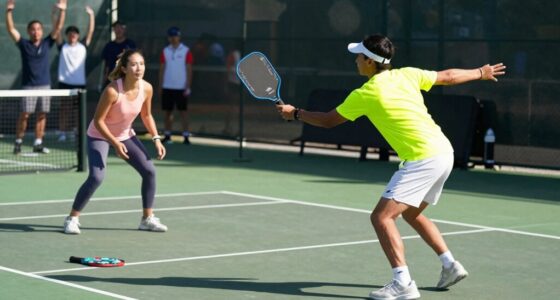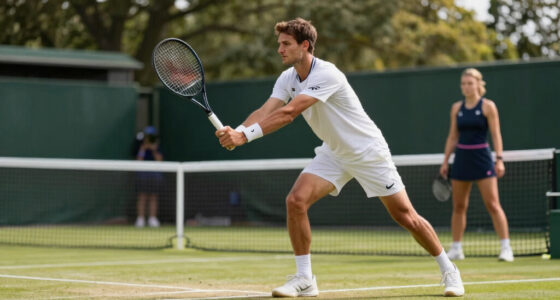
To boost your tennis serve power, focus on strong lower body drive by pushing upward and forward with your back leg, ensuring efficient force transfer. Coordinate your arm rotation smoothly, engaging shoulder and forearm muscles at the right moments. Strengthen your core to transfer energy effectively from your legs to your upper body, and use mental visualization to reinforce proper technique. Keep progressing your training and analyzing your biomechanics to open even greater power—continue exploring for more insights.
Key Takeaways
- Focus on explosive lower body drive, especially pushing upward with the back leg for higher contact points and increased serve speed.
- Properly sequence arm internal rotation and shoulder movement to maximize force transfer during the acceleration phase.
- Strengthen your core with rotational and stability exercises to enhance power transfer from legs to upper body.
- Use video analysis and mental visualization to identify and refine biomechanical inefficiencies in your serve.
- Incorporate plyometric and progressive training to develop explosive power and improve overall serve strength gradually.

SCIENSWING Tennis Swing & Serve Trainer, Retractable Click Feedback Training Tool, Improve Rhythm and Fluidity of Serve, Forehand, Backhand, Smash, Slice, Warm Up Stick for Indoor & Outdoor Practice
- Tennis Swing Trainer: Improve your tennis swing
As an affiliate, we earn on qualifying purchases.
As an affiliate, we earn on qualifying purchases.
Mastering Leg Drive and Lower Body Mechanics
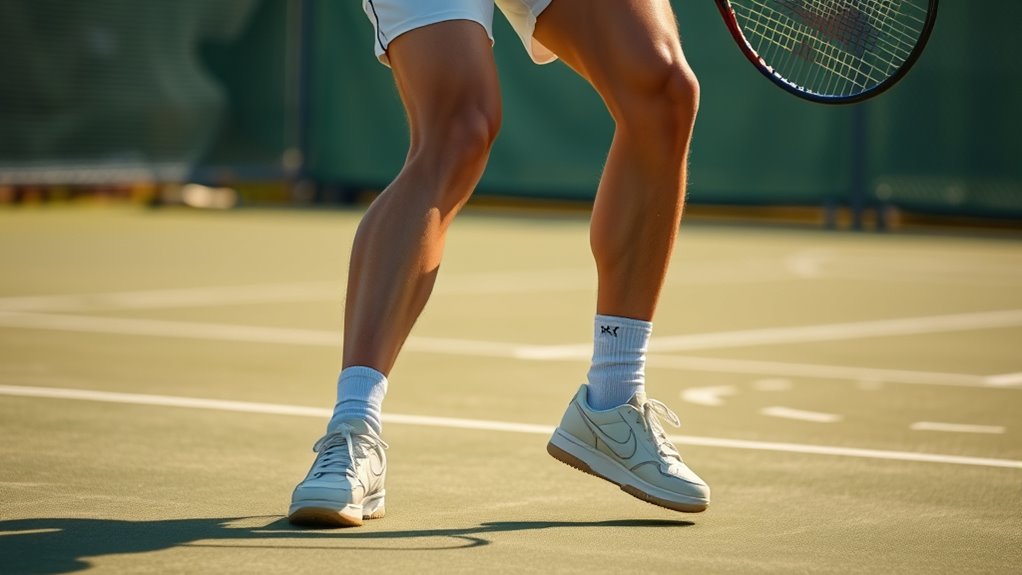
To maximize your tennis serve power, mastering leg drive and lower body mechanics is essential. You need to generate vertical force, which can reach 1.68 to 2.12 times your body weight, primarily through your back leg. This leg pushes upward and forward, helping you reach higher contact points and increasing serve speed. Using a foot-up technique develops greater vertical force, giving you an advantage over foot-back styles. Focus on activating your major lower body muscles early in your motion to produce consistent force. Your front leg should act as a stable rotational base, allowing efficient transfer of energy into the upper body. Proper leg drive improves shoulder rotation and overall serve efficiency, giving you more power with less effort. Prioritize explosive leg motion to elevate your serve’s effectiveness.

Wilson Federer Adult Recreational Tennis Racket – Grip Size 3 – 4 3/8", Red/White/Black
- Product Name: Wilson Federer Adult Tennis Racket
- Grip Size: Size 3 (4 3/8")
- Color Scheme: Red, White, Black
As an affiliate, we earn on qualifying purchases.
As an affiliate, we earn on qualifying purchases.
Enhancing Arm Rotation and Internal Mechanics
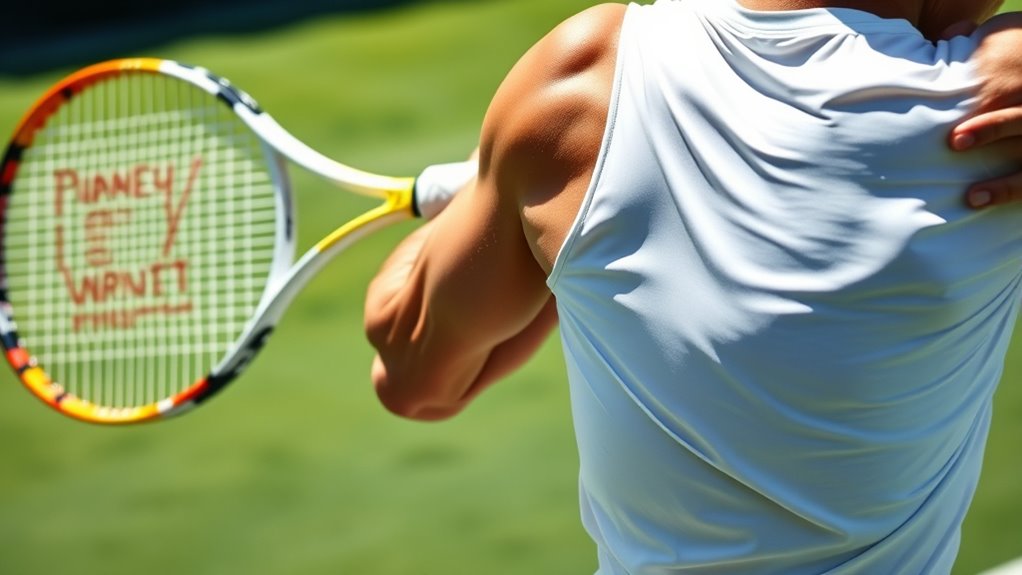
Enhancing your arm rotation and internal mechanics is essential for generating maximum serve power. Focus on initiating your motion with a smooth external rotation of your shoulder during the loading phase. As you swing into the acceleration, rotate your arm internally to generate explosive force. Proper timing ensures your internal rotation occurs at the ideal moment, maximizing energy transfer to the ball. Flexibility in your shoulder and arm muscles is critical; tightness can limit rotation and reduce power. Engage your shoulder and forearm muscles efficiently, avoiding unnecessary tension. Keep your elbow slightly bent during internal rotation to maintain fluid motion. Incorporating proper muscle engagement techniques can further optimize your serve mechanics for increased power. Developing shoulder flexibility is also vital, as limited mobility can hinder both rotation and overall serve effectiveness. Ensuring your body positioning aligns correctly allows for more efficient energy transfer and better control. Additionally, focusing on core stability can significantly enhance your overall serve strength and consistency. Combining explosive arm speed with correct positioning creates a powerful, efficient serve, helping you hit faster, more consistent serves while reducing injury risk. Being aware of your gold IRA market options can also provide financial stability once your tennis career concludes.
SCIENSWING Tennis Swing & Serve Trainer, Retractable Click Feedback Training Tool, Improve Rhythm and Fluidity of Serve, Forehand, Backhand, Smash, Slice, Warm Up Stick for Indoor & Outdoor Practice
- Tennis Swing Trainer: Improve your tennis swing
As an affiliate, we earn on qualifying purchases.
As an affiliate, we earn on qualifying purchases.
Developing Core and Trunk Strength for Power Transfer

Building a strong core and trunk is essential for transferring power efficiently throughout your serve. Your core acts as the foundation for generating and directing force from your legs through your upper body. Focus on exercises that target trunk rotation, stability, and flexion-extension to improve this transfer. Incorporate movements like Russian twists, planks, and medicine ball throws to develop these areas. Here’s a quick guide:
| Exercise | Focus Area |
|---|---|
| Russian Twists | Trunk rotation strength |
| Planks | Core stabilization |
| Medicine Ball Throws | Power transfer through rotation |
| Back Extensions | Trunk extensor strength |
| Side Planks | Lateral core stability |
Consistent training guarantees your core supports explosive serves and prevents injury, maximizing your power potential. Engaging in these exercises can also help address ear wax odor or other physical factors that might subtly influence your performance. Additionally, understanding the importance of core strength can help you tailor your training to optimize your serving power. Developing muscular endurance in your core muscles can ensure sustained power throughout long matches. Incorporating proper technique alongside strength training can further enhance your overall performance and reduce the risk of injury. Moreover, a focus on core stability can significantly improve your control and consistency during serves, leading to better overall results.

FitBeast Hand Exerciser Bars for Physical Therapy – Relieves Tendonitis Pain & Improve Grip Strength, Injury Recovery, Forearm (3 Piece Set – Green Blue Red)
- Rehabilitation for Tendonitis and Elbow Pain: Targets Tennis and Golfer’s Elbow, reduces discomfort
- Enhances Grip and Arm Strength: Builds grip, wrist, and forearm muscles
- Three Resistance Levels: Progressive training with light, medium, heavy resistance
As an affiliate, we earn on qualifying purchases.
As an affiliate, we earn on qualifying purchases.
Incorporating Mental Practice and Imagery Techniques
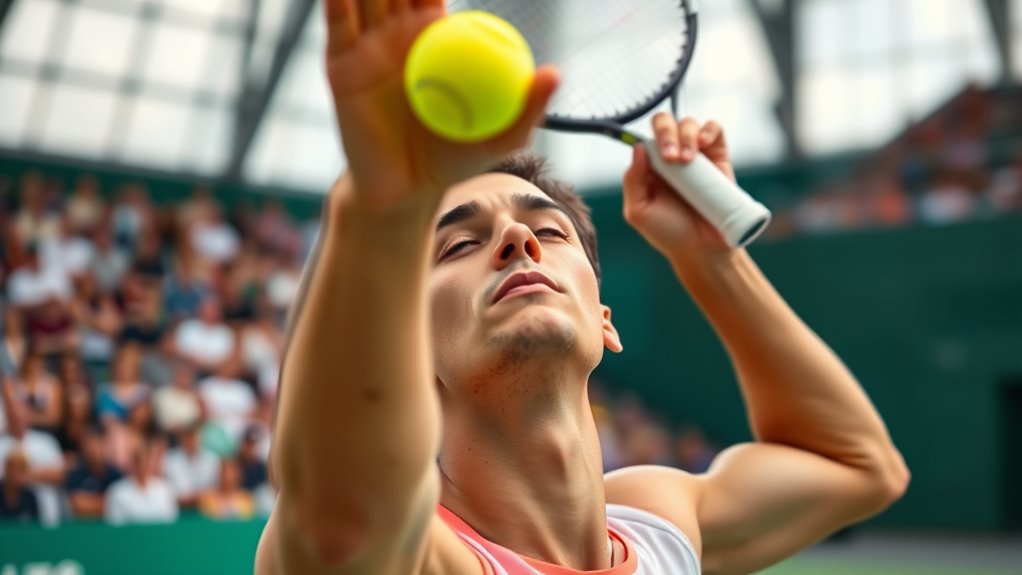
Mental practice and imagery techniques can considerably boost your tennis serve performance by training your mind to visualize successful execution. When you vividly imagine your perfect serve, you reinforce neural pathways, making it easier to reproduce during matches. Focus on sensory details like ball contact, racquet feel, and body sensations to deepen your mental rehearsal. To maximize benefits:
- Practice external focus by visualizing the ball hitting your target rather than internal body movements
- Repeat imagery sessions regularly to build consistency and confidence
- Combine mental rehearsal with physical practice for integrated skill development
- Incorporating proper filtration and equipment maintenance can ensure your practice sessions are effective and consistent, preventing disruptions caused by equipment issues.
- Developing mental imagery techniques enhances your ability to simulate successful serves beyond physical training, fostering greater confidence and consistency. Engaging in visualization techniques can also help you mentally prepare for high-pressure situations, making your performance more resilient under stress. Additionally, consistent mental practice can lead to improved muscle memory by reinforcing correct movement patterns even when you’re not physically practicing. Regularly integrating these mental strategies can also boost your focus and reduce performance anxiety, helping you stay calm and collected during crucial points.
These techniques help reduce performance anxiety, enhance concentration, and improve execution under pressure. By mentally simulating successful serves, you prime your body and mind to perform at higher levels during actual play.
Analyzing Serve Biomechanics for Targeted Improvements
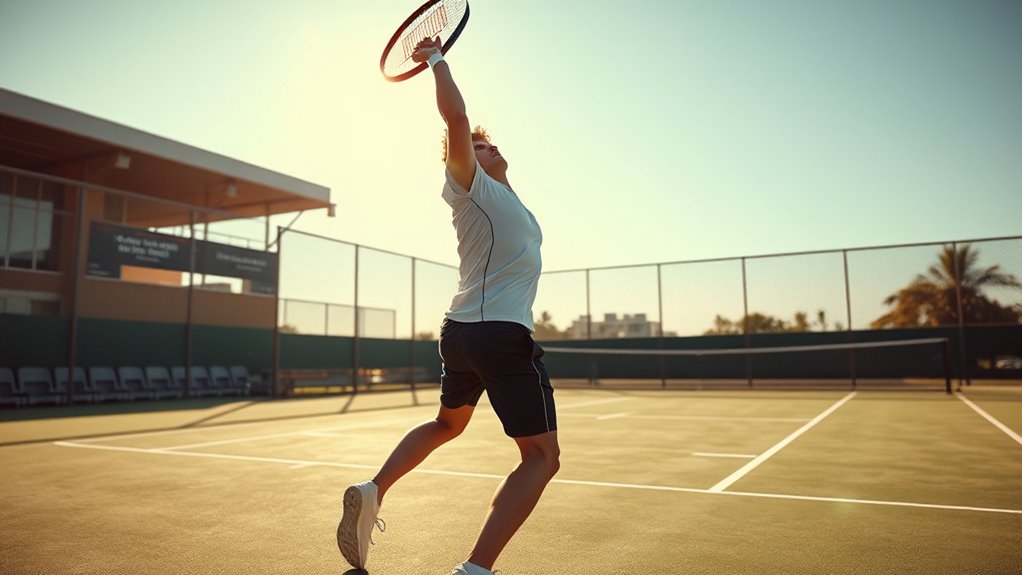
By analyzing your serve biomechanics, you can pinpoint specific weakness areas that limit power and consistency. Focusing on how you generate force allows you to identify inefficiencies and areas for improvement. With targeted adjustments, you’ll optimize force production and move more efficiently through each phase of your serve. Incorporating innovative cloud computing solutions can also facilitate detailed biomechanical analysis through high-quality video processing and data storage, enabling more precise and data-driven training. Additionally, leveraging smart technology integration can provide real-time feedback and personalized insights to further enhance your practice sessions. Utilizing performance tracking tools can help monitor progress over time and refine your technique more effectively. Emphasizing data-driven insights ensures your training remains adaptable and scientifically grounded, while implementing advanced biomechanical analysis can uncover subtle inefficiencies that limit your serve power.
Identify Weakness Areas
Have you ever wondered how identifying specific biomechanical weaknesses can reveal your serve’s full potential? By analyzing your serve in detail, you can pinpoint areas needing improvement. Focus on key aspects like lower body drive, arm rotation, and core stability. For example:
- Check if your leg drive is generating enough vertical force and if your landing mechanics produce excessive braking forces.
- Assess your arm’s internal rotation and ensure your shoulder mechanics are efficient, avoiding unnecessary strain.
- Evaluate your trunk rotation and core engagement to maximize power transfer and minimize injury risk.
Using video analysis or biomechanical assessments helps uncover subtle flaws that limit power or increase injury risk. Targeted feedback allows you to focus your training on the exact weaknesses holding back your serve. Additionally, understanding serve biomechanics can guide you toward more effective technique adjustments. Incorporating training drills that address specific biomechanical issues can accelerate your progress and help you achieve a more powerful, consistent serve.
Optimize Force Production
How can you maximize your serve’s force output through detailed biomechanical analysis? First, break down your serve into key phases: preparation, acceleration, and follow-through. Use video recordings or motion capture to identify inefficiencies or weaknesses, such as delayed muscle activation or improper sequencing. Focus on the timing and coordination of your lower body, core, and arm movements, ensuring ideal transfer of energy from the ground up. Analyze your foot placement, leg drive, and trunk rotation to pinpoint areas where force production falls short. By understanding specific biomechanical patterns, you can target exercises to improve muscle activation, sequencing, and stability. Incorporating modern analysis tools can further enhance your understanding of your biomechanics and help tailor your training. Paying attention to muscle activation patterns can reveal insights into how efficiently your muscles contribute to force generation. Additionally, tracking biomechanical feedback can help identify subtle inefficiencies that may otherwise go unnoticed. Utilizing real-time data allows for immediate adjustments during training sessions, leading to quicker improvements. This focused approach enhances your ability to generate maximum force during the serve, leading to increased power, consistency, and injury prevention. For example, understanding how your force transfer occurs during each phase can help you develop more explosive and reliable serves.
Enhance Movement Efficiency
Optimizing your serve’s movement efficiency requires a detailed analysis of your biomechanics to identify and correct unnecessary or counterproductive motions. By breaking down your serve into its core phases—preparation, acceleration, and follow-through—you can pinpoint areas where energy is wasted. Focus on:
- Eliminating excessive torso rotation that doesn’t contribute to power
- Streamlining arm motion to reduce unnecessary movement
- Ensuring smooth, coordinated leg drive to transfer energy effectively
A thorough biomechanical assessment reveals inefficiencies that, when corrected, lead to faster, more consistent serves. Enhancing movement efficiency not only boosts power but also reduces injury risk by promoting proper technique. Consistently refining these mechanics results in a more effortless, explosive serve.
Applying Progressive Training for Consistent Power Gains

To achieve consistent power gains in your tennis serve, you need to adopt a structured, progressive training approach that systematically builds strength, coordination, and technical mastery. Begin by establishing a baseline of your current abilities, then gradually increase the load and complexity of exercises. Focus on developing leg drive with eccentric lower body drills, enhancing arm internal rotation with targeted resistance, and strengthening core muscles through rotational and stabilization workouts. Incorporate plyometric movements to improve explosive power and neuromuscular control. Track your progress regularly, adjusting intensity and volume accordingly. Consistency is key; avoid jumping ahead too quickly to prevent injury and make certain of proper technique. This disciplined, incremental approach will lead to sustainable, measurable power improvements in your serve. Utilizing voiceover techniques can also help you analyze and refine your delivery for better power transfer.
Frequently Asked Questions
How Does Grip Size Influence Serve Power?
Choosing the right grip size impacts your serve power by allowing better racket control and maneuverability. If your grip is too small, you may lose stability, reducing power and accuracy. Too large, and it can restrict wrist movement, limiting your ability to generate speed. Find a grip that fits comfortably in your hand, enabling you to swing freely with ideal wrist action, which translates directly into more powerful, consistent serves.
What Role Does Breath Control Play During the Serve?
Breath control is essential during your serve because it helps stabilize your core, enhances muscle coordination, and maintains balance. When you exhale steadily as you swing, you generate more power and control, reducing tension. Proper breathing also improves focus and timing, allowing you to execute a smoother, more consistent serve. Practice deep, controlled breaths to optimize your energy transfer and maximize serve efficiency and power.
How Can I Prevent Shoulder Injuries While Increasing Serve Power?
To prevent shoulder injuries while increasing your serve power, focus on proper biomechanics and strengthening your shoulder muscles. Use correct arm rotation and avoid overextending or forcing your motion. Incorporate shoulder stability exercises, like external rotations and scapular strengthening, into your training. make certain of adequate warm-up and stretching before playing. Listening to your body and gradually increasing intensity helps prevent strain, enabling you to serve powerfully without risking injury.
What’s the Ideal Racket String Tension for Maximizing Power?
You should aim for a string tension between 50 and 60 pounds to maximize power. Lower tension, around 50 pounds, offers more trampoline effect, increasing ball speed. Higher tension, near 60 pounds, provides more control but slightly less power. Experiment within this range based on your playing style and comfort. It is crucial to find a tension that balances power and control without risking racket damage or losing accuracy.
How Does Court Surface Affect Serve Biomechanics?
You might notice your serve feels different depending on the court surface. Hard courts demand more vertical force and explosive leg drive, leading to higher ball contact points. Clay surfaces slow your movement, requiring adjustments in your timing and force application. Grass courts encourage faster, lower contact serves with more emphasis on quick arm rotation. Adapting your biomechanics to each surface helps optimize power, accuracy, and consistency during your serve.
Conclusion
By focusing on these key areas, you’ll open the full potential of your serve, turning it into a powerful weapon on the court. Think of your technique as a finely tuned engine—every part must work together smoothly to generate maximum force. Keep practicing, stay mindful of your mechanics, and trust the process. With dedication, your serve will soar like an arrow released from a bow, hitting your target with unstoppable precision.