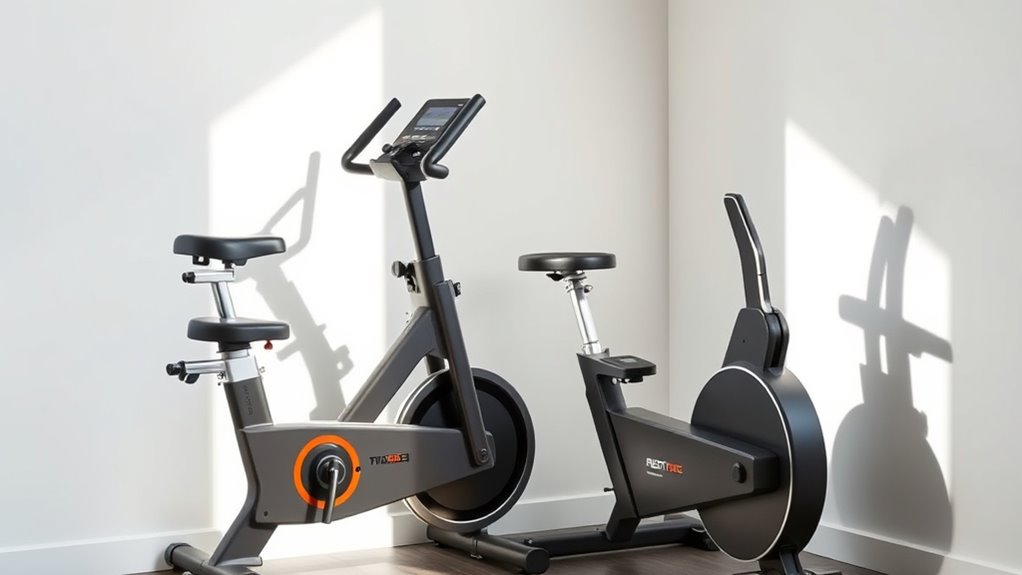

Choosing between an upright or recumbent exercise bike depends on your fitness goals and comfort preferences. Upright bikes offer a more intense, engaging workout with greater muscle activation, ideal for calorie burning and higher endurance. Recumbent bikes prioritize comfort and support, making them better for beginners, seniors, or those with joint issues. Considering space and budget also influences your choice. Keep exploring to discover which bike fits your needs best and helps you achieve your fitness targets.
Listen free for 30 days with Audible
Thousands of audiobooks and originals — cancel anytime.
As an affiliate, we earn on qualifying purchases.
Key Takeaways
- Upright bikes offer higher intensity workouts and muscle engagement, ideal for fitness enthusiasts seeking challenge.
- Recumbent bikes prioritize comfort and lower joint impact, suitable for beginners, seniors, or rehab users.
- Space and placement considerations favor upright bikes for smaller areas, while recumbent bikes require more room due to their size.
- Upright bikes tend to be more affordable and easier to maintain; recumbent bikes often come at a higher cost with added comfort features.
- Your fitness goal, physical condition, and space availability determine which bike type is better suited for your needs.
Differences in Design and Comfort

When choosing between an upright and a recumbent exercise bike, understanding their design differences is key to finding the most comfortable option for you. An upright bike mimics traditional cycling, with a compact frame and a vertical seating position, offering ergonomic benefits that engage your core muscles. Its aesthetic appeal often resembles a regular bicycle, making it familiar and sleek. Conversely, a recumbent bike features a larger seat with back support and a reclined position, reducing strain on your lower back and joints. This design prioritizes comfort, especially for longer workouts, and appeals to those seeking a more relaxed, supportive experience. Your choice depends on whether you prefer a more traditional, space-efficient design or one that emphasizes comfort and ergonomic support.
Impact on Workout Intensity and Performance
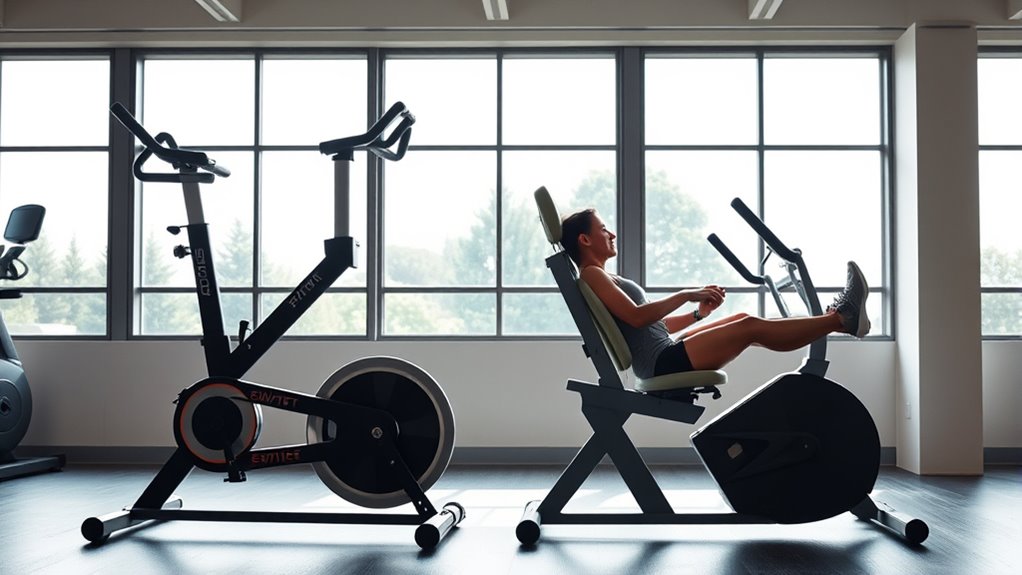
The design of an upright or recumbent exercise bike considerably influences your workout intensity and performance. An upright bike typically boosts your cardiovascular impact by engaging more muscles, allowing you to push harder and burn more calories. Its ergonomic benefits include a natural riding position that can enhance your effort and endurance. Conversely, a recumbent bike offers a more comfortable setup, reducing strain on your joints, but may limit the intensity you can achieve. If you’re aiming for high-intensity workouts, an upright bike might be more effective due to its ability to activate more muscle groups. Additionally, adjustable resistance on both types of bikes helps tailor the workout to your fitness level and goals. However, both bikes can improve your performance over time, depending on your fitness goals and commitment. Your choice impacts how vigorously you can exercise and how much you can challenge yourself.
Suitability for Different Fitness Levels
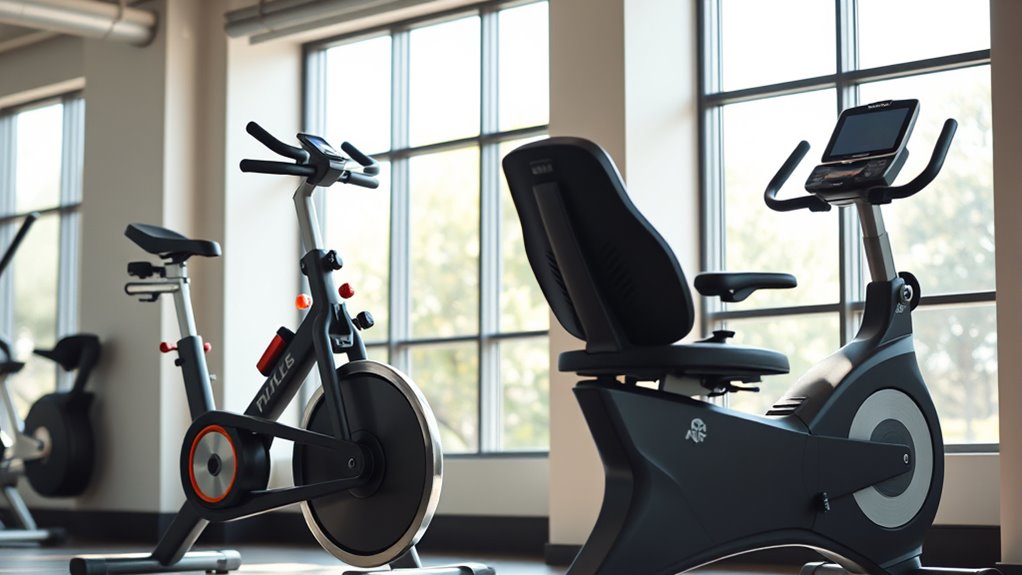
Choosing between an upright and recumbent exercise bike depends heavily on your current fitness level and workout experience. If you’re a beginner, a recumbent bike may be more suitable due to its ergonomic benefits, offering better back support and comfort during workouts. Its low-impact design reduces strain, making it easier to build endurance safely. On the other hand, upright bikes tend to be more challenging and better suited for intermediate or advanced users looking to increase intensity and engage more muscle groups. Both bikes can accommodate different fitness levels, but your choice should reflect your comfort, experience, and goals. Starting with a recumbent bike can help you gradually improve fitness, while an upright bike can elevate the challenge as you progress.
Space and Placement Considerations

When choosing where to place your exercise bike, consider how much space it needs and how flexible the setup can be. You’ll want to think about room requirements and whether the bike fits comfortably without crowding your other furniture. Also, explore storage options to keep your space organized when the bike isn’t in use. Additionally, assessing the projector placement ensures optimal viewing angles and minimizes shadows or glare during your workouts or entertainment sessions. Properly space planning can enhance safety and make your workout area more inviting and efficient. Taking into account available space and the potential for integrating connected fitness technology can help you select the best bike type for your environment and maximize your workout comfort. Considering ventilation and airflow can also improve overall comfort and safety during your exercise routines.
Room Requirements
To guarantee your exercise bike fits comfortably and functions safely, you need to take room size and placement into account carefully. Make sure there’s enough space around the bike for easy entry, exit, and movement, which enhances ergonomic benefits by reducing strain during workouts. Recumbent bikes generally require more floor space due to their larger footprint, but they can blend well with your room’s aesthetic appeal because of their sleek design. Upright bikes are more compact, fitting into smaller spaces without sacrificing functionality. Consider the height clearance for user comfort and safety, especially if you plan to use accessories or monitor screens. Proper placement not only improves ergonomic benefits but also creates an inviting environment that encourages regular exercise. Additionally, paying attention to room organization can help maintain a safe and accessible workout area, especially for seniors with mobility considerations. Ensuring adequate storage solutions for your equipment can further optimize your exercise space and promote consistency. Incorporating smart layout strategies can also help maximize space efficiency and keep your workout area clutter-free. Incorporating field-of-view considerations can help ensure visibility and safety during exercise sessions.
Placement Flexibility
Placement flexibility varies between upright and recumbent bikes, influencing how easily you can incorporate them into your space. Upright bikes typically require less room for bike placement, making them suitable for smaller areas or rooms with limited space. They fit well in standard rooms without disrupting other furniture or activity zones. Recumbent bikes, on the other hand, often demand more room for comfortable room compatibility due to their larger footprint and reclined design. If your space is limited, an upright bike might be more practical for seamless placement. Consider your available room and how much space you’re willing to accommodate to your workout area. Proper placement ensures safe, efficient use while maintaining the overall flow of your room. Additionally, space optimization can help you make the most of your workout area by arranging equipment efficiently, much like AV setup strategies optimize living room functionality. Ensuring proper room layout can enhance both safety and comfort during exercise. In some cases, adjustable bike positioning features can further aid in customizing your workout space for optimal use. Furthermore, considering ergonomic design can improve your comfort and reduce strain during workouts.
Storage Options
Storage options for upright and recumbent bikes depend largely on their size and how much space you’re willing to allocate. Vertical storage is a popular choice, especially for those with limited space, as it allows you to store your bike upright against a wall. Wall-mounted options are highly effective, freeing up floor space and making it easy to tuck your bike away when not in use. You can install wall hooks or racks designed specifically for exercise bikes, providing secure support and quick access. Recumbent bikes, which tend to be bulkier, benefit from these space-saving solutions just as much. Consider your available room and choose a storage method that keeps your workout area organized and clutter-free. Proper storage ensures your bike stays in good condition and is ready whenever you are. Embracing compact living principles can help you optimize your exercise space and maintain a tidy environment. Additionally, selecting appropriate storage equipment can further enhance safety and convenience, especially when considering space-saving solutions for larger equipment. To maximize your space, you might also explore multi-purpose furniture that can double as storage for your exercise gear. Incorporating modular storage options allows for flexible organization tailored to your available space.
Cost and Maintenance Factors
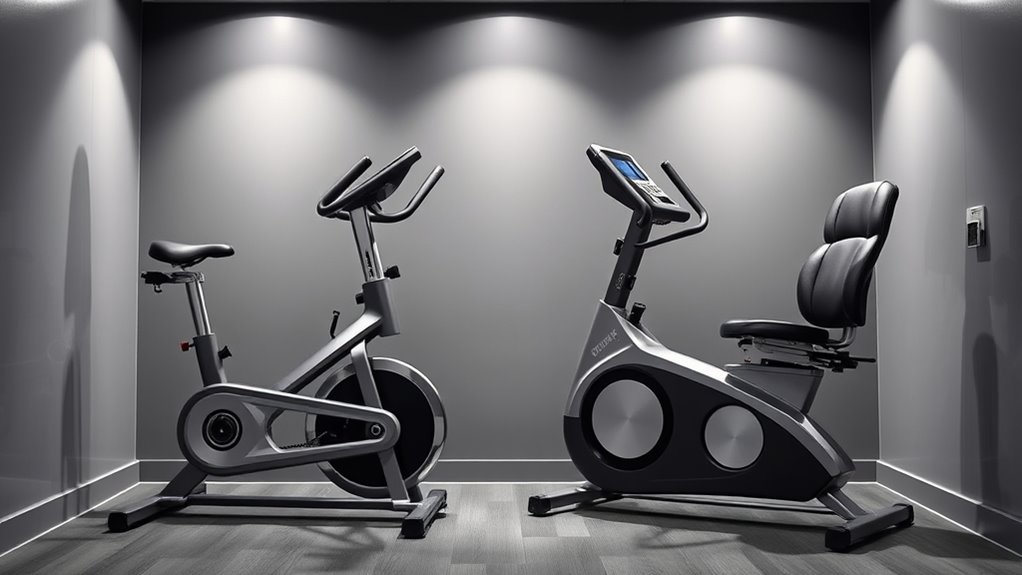
When comparing upright and recumbent exercise bikes, the initial cost and ongoing maintenance expenses can vary considerably. In a price comparison, upright bikes tend to be more affordable upfront, making them a popular choice for budget-conscious users. Recumbent bikes often cost more initially but offer added comfort, which may justify the higher price for some. Maintenance costs are generally low for both types, involving occasional belt or chain checks, lubricating moving parts, and replacing worn-out components. Upright bikes typically have simpler mechanisms, potentially resulting in slightly lower maintenance needs. Recumbent bikes, with their more complex frames and larger components, might require a little more attention over time. Additionally, thermal behavior of the bikes can influence long-term durability and performance, especially in outdoor or varied environments. Proper storage and ventilation can help mitigate issues related to heat buildup that may affect electronic components or lubricants. Recognizing manufacturer quality can also impact the longevity and reliability of your exercise bike. Being aware of environmental factors can help extend the lifespan and maintain the optimal functioning of your exercise bike. Overall, your choice should consider both initial investment and the expected ongoing upkeep.
Ideal Users for Each Type
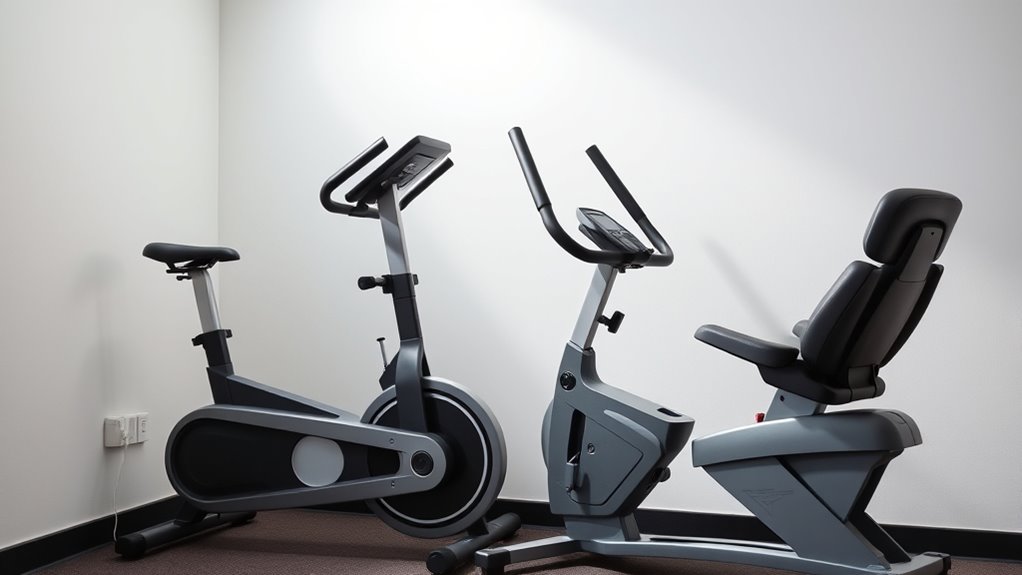
Upright and recumbent exercise bikes suit different types of users based on their fitness goals, physical comfort, and space constraints. If you want an engaging workout that mimics outdoor cycling and targets overall fitness, an upright bike offers ergonomic benefits and active engagement. Conversely, if comfort and low-impact exercise are priorities, especially for those with back or joint issues, a recumbent bike provides better ergonomic support. Consider your target demographics: seniors often prefer recumbent bikes for stability, while young adults may opt for upright models for intensity. Here’s a quick comparison:
| Feature | Upright Bike | Recumbent Bike |
|---|---|---|
| Ideal Users | Fitness enthusiasts | Seniors, rehab patients |
| Ergonomic Benefits | Engages core muscles | Supports back and joints |
| Space Requirements | Moderate | Space-efficient |
| Target Demographics | Active, young adults | Elderly, those with injuries |
| Workout Intensity | High | Moderate to low |
Frequently Asked Questions
Which Bike Type Is Better for Rehabilitation or Injury Recovery?
You should choose a recumbent bike for rehab suitability and injury support, as it offers more stability and reduces strain on your joints. Its ergonomic design helps you maintain proper posture, making it easier to perform gentle, controlled movements. This bike type minimizes impact and is ideal if you’re recovering from injuries or surgeries, providing a safer, more comfortable option for gradual rehabilitation and rebuilding strength without risking further injury.
How Do Noise Levels Compare Between Upright and Recumbent Bikes?
You’ll find that recumbent bikes generally have lower sound levels compared to upright bikes, making them quieter during use. Their sound comparison reveals less noise from the larger, more stable frame and smoother, less intense pedaling motion. If quiet operation matters to you, especially in shared living spaces or apartments, a recumbent bike is the better choice, providing a more peaceful workout without disturbing others.
Can Both Bikes Accommodate Users With Varying Height Ranges Comfortably?
You’ll find that most bikes can accommodate a wide height range, with adjustable seat height and handlebar options. An interesting statistic: recumbent bikes often fit users from 4’10” to 6’4”, while upright bikes usually suit those from 5’0” to 6’5”. To guarantee comfort, check for easily adjustable seat height and handlebar positions, so you get a personalized fit regardless of your height.
Are There Specific Models That Combine Features of Both Bike Types?
Yes, you can find hybrid models that combine features of both upright and recumbent bikes. These bikes often have adjustable features, allowing you to switch between upright and recumbent positions easily. This versatility helps you customize your workout and find the most comfortable posture. Look for models with adjustable seats, handlebars, and resistance levels, so you can adapt the bike to your preferences and fitness goals seamlessly.
What Are the Long-Term Durability Differences Between Upright and Recumbent Bikes?
You’ll find that upright bikes often have durability differences due to their materials, like heavier frames and reinforced components, making them last longer with proper maintenance. Recumbent bikes, while generally sturdy, sometimes use lighter materials, which can wear faster over time. To guarantee longevity, choose models with high material quality, regardless of type. Regular maintenance also plays a key role in maintaining durability, so stay attentive to your bike’s condition.
Conclusion
So, whether you’re team upright or team recumbent, remember that the real winner is your couch, waiting patiently. Choose based on comfort, space, and your fitness goals—because who doesn’t want a workout that’s as enjoyable as a root canal? Whichever bike you pick, just be glad you’re not trying to do a plank on a unicycle. Happy pedaling—may your sweat be minimal and your excuses plentiful!
Fall Picks
fall essentials
As an affiliate, we earn on qualifying purchases.