

To keep score in tennis, start with points: 0 (love), 15, 30, and 40, then win a game. If both players reach 40, it’s deuce. From deuce, win two points to take the game. A set is won when you reach 6 games with a 2-game lead. At 6-6, a tiebreak occurs where the first to 7 points, with a 2-point lead, wins. There’s more to scoring you’ll want to explore for a deeper understanding!
Key Takeaways
- Tennis scoring progresses from 0 (love) to 15, 30, 40, and then to game, with players alternating serves.
- A game reaches deuce when both players score 40; a player needs two consecutive points to win from deuce.
- Sets are won by the first player to win 6 games with at least a 2-game lead; at 6-6, a tiebreaker is played.
- In a tiebreak, players compete to be the first to reach 7 points, needing a 2-point lead to win.
- Understand terminology like “break” and “advantage” to enhance comprehension of match dynamics and strategies.

When you step onto the court, understanding how to keep score in tennis is essential for enjoying the game. Knowing the scoring terminology is critical for tracking match progression and ensuring you’re engaged throughout. In tennis, the scoring system is unique, and grasping it can enhance your experience, whether you’re playing or watching.
The game begins with players serving. Each player takes turns serving, and the player who’s serving tries to win points by hitting the ball into the opponent’s court. Points are counted in a sequence: 0 (or “love”), 15, 30, 40, and then game. If both players reach 40, it’s called “deuce.” From deuce, a player must win two consecutive points to claim the game. If you win the first point after deuce, you have the “advantage.” If you lose that point, it goes back to deuce. Understanding this flow is essential for following the match progression.
A set is won by the first player to win six games, provided they lead by at least two games. If the score reaches 5-5, a player must win two games to take the set. If it goes to 6-6, a tiebreaker is played. In a tiebreak, the first player to reach seven points wins, but they must lead by a margin of two points. This scoring nuance adds excitement and drama, making each point critical.
Now, let’s talk about the overall match. Tennis matches can be played in best-of-three or best-of-five sets, depending on the tournament. This structure means that you need to focus on not only winning individual games but also the overall set and match. Keeping track of how many sets each player has won helps you gauge the match’s intensity.
Remember, the terms “game,” “set,” and “match” are all part of the scoring terminology you’ll encounter. When you hear someone say “he’s up a break,” it means one player has won a game on the opponent’s serve, giving them a significant advantage. Understanding these phrases will help you follow conversations about the match and appreciate the strategy involved.
As you familiarize yourself with these scoring fundamentals, you’ll find that following a tennis match becomes more enjoyable and engaging. Whether you’re playing or spectating, mastering the scoring system is key to fully experiencing the sport. Additionally, similar to how contrast ratios affect image quality in projectors, the nuances of scoring can greatly impact your appreciation of the game’s strategy.

Scoring Right Portable Tennis Racket and Padel Scorekeeper, Easily Mounted Small Score Board to Keep Score of Points, Games, and Sets, ITF Conforming, Lightweight Mini Score Keeper, 1.9g, White
Lightweight & Practical: The convenient, lightweight, and portable score keeper is the perfect way to keep track of…
As an affiliate, we earn on qualifying purchases.
As an affiliate, we earn on qualifying purchases.
Frequently Asked Questions
What Do the Terms “Deuce” and “Advantage” Mean in Tennis Scoring?
In tennis terminology, “deuce” means both players have a score of 40-40, requiring one player to win two consecutive points to win the game. When you gain that first point after deuce, you get “advantage,” which indicates you’re one step closer to winning the game. If your opponent wins the next point, it goes back to deuce, showcasing the importance of these scoring vocabulary terms in tight moments during a match.
How Is the Tie-Breaker Scored in a Tennis Match?
When the score’s tied, you enter that critical moment—the tie-breaker. In tie break scoring, you need to reach seven points, but you must win by at least two. You start by serving once, then alternate every two points. As for tie break rules, if the game reaches 6-6, this format kicks in, giving both players a chance to shine. It’s a thrilling race to the finish, making every point count!
Can Players Call Their Own Lines During a Match?
Yes, you can call your own lines during a match, especially in recreational play or lower-level competitions. However, in professional matches, the umpire has the final responsibility for line calling. If you’re unsure about a call, it’s best to communicate with your opponent. Remember, honesty is key in maintaining fair play. Always respect the umpire’s decisions, as they’re there to guarantee the match runs smoothly and fairly for everyone involved.
What Happens if a Player Serves Out of Turn?
If you serve out of turn, it’s like stepping onto the wrong stage during a performance. The match pauses as the umpire steps in, juggling their responsibilities. They’ll call a serving fault, and the opposing player gains the point. It’s important to stay alert and know when it’s your turn to serve, ensuring the game flows smoothly. So, keep your focus sharp and avoid that mix-up to maintain the rhythm of play.
How Is Scoring Different in Doubles Compared to Singles?
In doubles, you’ll notice scoring involves more teamwork and communication compared to singles. Each player on a team works together, often employing doubles strategies to outmaneuver opponents. You’ll need to coordinate your movements and shots, which can affect how points are won. The serving rotation also changes, requiring you to be aware of your partner’s position and strengths. Overall, doubles scoring is about collaboration and adapting to your partner’s play style.

Sonwyoung 1 Pack Over Net Tennis Score Keeper Flip Scoreboards Portable for Volleyball Basketball Coaching Tennis Outdoor (Numbers 0-9,Black)
Tennis Companion: most tennis courts don't give you scores, so this scoreboard is the suitable solution for courts…
As an affiliate, we earn on qualifying purchases.
As an affiliate, we earn on qualifying purchases.
Conclusion
Now that you know how to keep score in tennis, you can savor the thrill of a match like a painter enjoying each brushstroke on a canvas. The tension builds with every point, like a tightrope walker balancing high above the ground. Remember, each game is a dance between players, where every score is a heartbeat in the rhythm of competition. So grab your racquet, embrace the challenge, and let the scoreboard tell your story on the court!
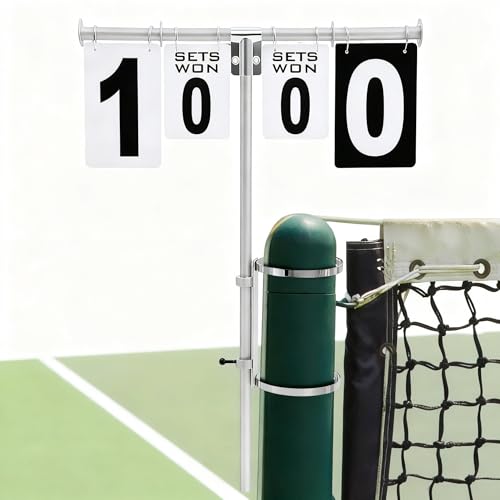
Silipull 1 Set Tennis Scoreboard Tennis Score Keeper for Net Compatible with Most Score Board Set for Volleyball Basketball Outdoor
Portable Setup: with tennis scoreboard overall size about of 28.4 x 20.7 inches/ 72 x 52.5 cm, the…
As an affiliate, we earn on qualifying purchases.
As an affiliate, we earn on qualifying purchases.

Match Tuff Ez-Score (0-9) | Portable Tennis Score Keeper | Outdoor & Indoor | EZ-Flip
Each number is 5" x 2-1/2"
As an affiliate, we earn on qualifying purchases.
As an affiliate, we earn on qualifying purchases.