

To keep score in tennis, track each player’s points—starting at 0, then progressing to 15, 30, 40, and game point. Note when both players reach 40-40, called deuce, and mark advantage if needed. Count games for each set, where winning six with a two-game lead wins the set. If tied at 6-6, record a tiebreak and track its points. Accurate scorekeeping reveals match flow; continue to explore for in-depth techniques.

Get workout gear delivered free with Prime
- Fast, free delivery on millions of items
- Prime Video, Amazon Music and more included
- Member-only deals all year
Key Takeaways
- Track each player’s points from 0, 15, 30, 40, and game point, updating after every rally.
- Record the number of games won by each player, noting when they reach six with a two-game lead.
- Use a tiebreak at 6-6 in games, tracking points and alternating serve every two points until one player wins by two.
- Keep detailed stats like aces, double faults, and break points for advanced performance analysis.
- Maintain consistent, clear notation to monitor momentum shifts, deuce, advantage, and critical game moments.
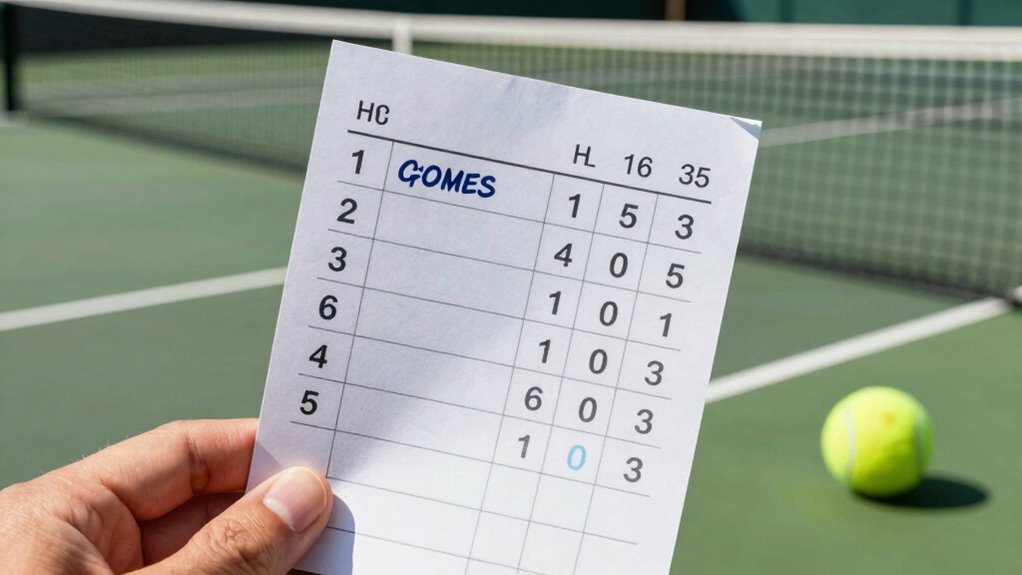
Have you ever wondered how tennis players and officials keep track of points during a match? It’s a system that might seem complex at first, but once you understand the basics, it becomes much easier to follow. The core of tennis scoring revolves around a unique sequence of points, games, and sets. When a player wins a point, their score advances from 0 to 15, then 30, then 40, and finally the game point. If both players reach 40-40, it’s called deuce, and from there, players must win two consecutive points to claim the game—first gaining advantage, then winning the game if they secure the next point.
Understanding tennis scoring: from 0 to 15, 30, 40, and the importance of deuce and advantage points.
As the game progresses, you need to keep track of who wins each point, adding each to the respective player’s tally. Once a player wins enough games—typically six with a margin of at least two games—they win the set. When players reach a set score of 6-6, the tiebreak rules come into play. Instead of continuing to play games, a tiebreak is used to determine the set winner in a more straightforward manner. During a tiebreak, players alternate serve every two points, and the first to reach at least seven points with a two-point lead wins the set. Tiebreak rules help keep matches moving efficiently and prevent overly long sets, especially in competitive play.
To master scoring in tennis, you might also explore advanced scoring techniques. These include tracking stats like first serve percentage, break points saved, or even the number of aces, which can give you a deeper understanding of the match’s flow. While these aren’t part of the basic scorekeeping, they’re useful for players and coaches looking to analyze performance more thoroughly. Understanding scoring terminology can also help you communicate more effectively during a match or coaching session.
Keeping score in tennis isn’t just about tallying points; it’s about understanding the rhythm of the game. When you keep score properly, you also learn to anticipate the momentum shifts, especially during critical moments like deuce or tiebreaks. Using a clear and consistent method to track each point, game, and set will make following the match easier for you and others. Additionally, familiarizing yourself with match duration factors can help you better manage your viewing or playing schedule. Knowing how to properly record and interpret scores can also aid in performance analysis, allowing players to identify strengths and areas for improvement. Developing a scorekeeping system that suits your style can make tracking progress more intuitive and enjoyable. Whether you’re a casual fan, a beginner player, or an aspiring umpire, knowing the tiebreak rules and some advanced scoring techniques enhances your appreciation of the game’s intricacies. It’s a skill that sharpens your focus and helps you stay engaged from the first serve to the final point.
As an affiliate, we earn on qualifying purchases.
Frequently Asked Questions
How Do Tie Games Affect the Overall Score?
Tie games, or deuce scenarios, reset the score to 40-40, affecting your scoring history by requiring you to win two consecutive points to secure the game. Historically, changes like the introduction of advantage rules have clarified how ties influence the overall score. These tie situations add tension and prolong the match, making each point critical. They guarantee the game remains competitive and fair, reflecting tennis’s evolving scoring system over time.
What Is the Significance of Deuce and Advantage?
Imagine a delicate dance on the court where deuce significance keeps the rhythm alive, signaling both players are evenly matched. The advantage importance then takes center stage, offering a fleeting moment of hope for the player who seizes it. This exchange heightens tension and excitement, emphasizing the vital importance of each point. Deuce and advantage are the heartbeat of tennis, turning a simple game into a thrilling battle of wills.
How Is a Match Won in Best-Of-Five Sets?
In a best-of-five sets match, you win by securing three sets before your opponent does. You keep track of the scoring history, noting each set’s winner, which reflects your skill and current player rankings. To clinch the match, you need to consistently outperform your opponent across multiple sets, demonstrating stamina and strategy. Winning three sets decisively ends the match, advancing your position in rankings and boosting confidence.
Are There Different Scoring Rules for Doubles?
Yes, doubles have some different scoring rules, mainly in doubles communication and serving strategies. You and your partner need to coordinate your serves and returns, often alternating in a specific pattern. Serving strategies focus on targeting open spaces and mixing up serves to keep opponents off balance. Good communication is essential to avoid confusion, decide who takes shots, and execute seamless plays, which can influence the score and overall game flow.
How Are Tie-Breaks Scored Differently?
Tie-break rules differ from regular scoring, offering a faster way to decide a set. When a game reaches 6-6, you play a tie-break, where each point counts individually. The first player to reach 7 points with a two-point lead wins the tie-break and the set. Scoring variations like this help prevent endless games, and understanding these rules guarantees you adhere to the official format during matches.
As an affiliate, we earn on qualifying purchases.
Conclusion
So, next time you’re counting points in tennis, remember—despite all the quirks and quirks, it’s just a game. The real score isn’t in the numbers but in the laughs, lessons, and moments shared on the court. Ironically, while keeping score can seem so serious, it’s the fun and camaraderie that truly make the game worth playing. So, relax, enjoy, and maybe even forget the score—after all, isn’t that what makes tennis so addictive?
As an affiliate, we earn on qualifying purchases.
As an affiliate, we earn on qualifying purchases.
Columbus Day / Indigenous Peoples' Day Picks
long weekend sales
As an affiliate, we earn on qualifying purchases.