
TL;DR

Get workout gear delivered free with Prime
- Fast, free delivery on millions of items
- Prime Video, Amazon Music and more included
- Member-only deals all year
Fit&Well published a yoga therapist’s seven-part seated movement routine, designed for older adults and people who prefer or need chair-based movement. The exercises use a sturdy chair and are presented as adaptable movement, not as a treatment or a guaranteed health benefit.
Fit&Well has published a yoga therapist’s seven-part chair exercise routine for older adults and others who find floor-based movement difficult or prefer to exercise seated. The flow combines breathing with arm movements, gentle torso mobility and forward folding, and the therapist says participants can adapt each movement to their own capacity.
The therapist describes using chair-based yoga with older adults, including people living with Parkinson’s, other movement disorders and chronic health conditions. In the report, the therapist says seated movement can include stretching muscles, mobilizing joints and paying attention to the body. Those are the therapist’s descriptions of the practice, not findings from a clinical study presented in the article.
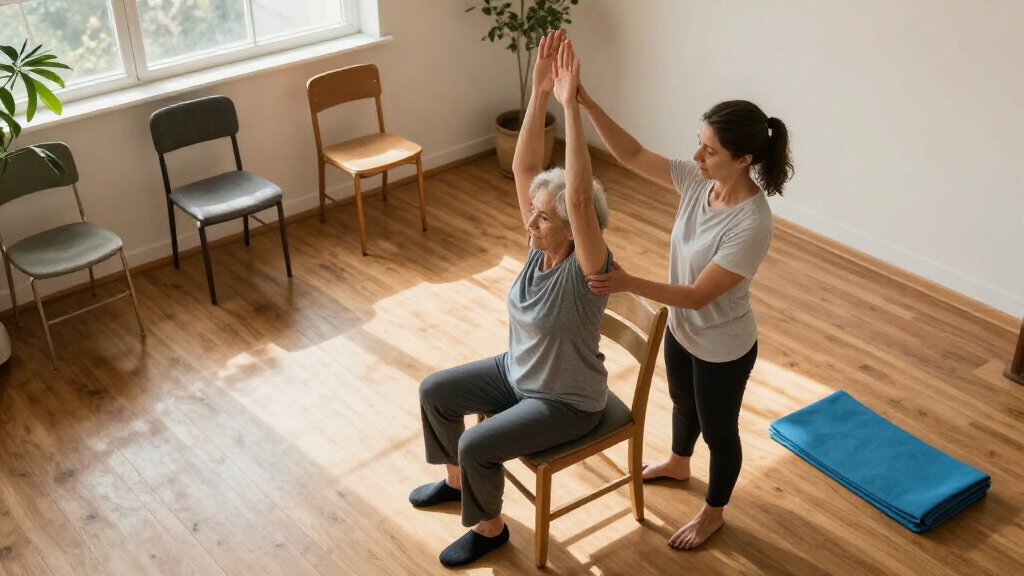
The sequence begins with a minute of settling into a supported sitting position: feet flat, hands resting on the lap and breathing allowed to return to a natural rhythm. It then moves through arm arcs into prayer, seated twists, alternating arm raises, side bends, a seated cat-cow movement and a forward fold. Most steps call for three to five repetitions, or three on each side for the twists and side bends.
The instructions include ways to adapt the movements. For a side bend, a participant can hold the chair instead of extending an arm down; during the forward fold, hands can stay on the knees for extra support. The report advises moving within the body’s accessible range rather than trying to achieve a particular shape. It recommends a sturdy chair and enough clear space to raise the arms.
A Seated Option for Gentle Movement
The routine offers a chair-based alternative for readers who cannot comfortably get down to the floor, have limited mobility or simply prefer seated movement. Because the exercises are laid out in short, repeatable steps, readers can see what the flow involves before deciding whether it suits them.
The therapist also stresses that the movements should be adjusted to each person, rather than performed to match an ideal posture. That distinction matters for readers managing balance, mobility or ongoing health concerns: the report is an exercise recommendation, not an individualized assessment. People unsure whether a movement is appropriate for them may want guidance from a health professional familiar with their circumstances.
Products Worth Considering

Fitbit Sense 2 Smartwatch – Blue Mist / Pale Gold

Therabody Theragun Mini 3rd Generation Massage Gun, Black

Garmin Venu® 3 Premium Fitness Smartwatch 45mm Black
As an affiliate, we earn on qualifying purchases.
How the Seven-Part Flow Works
The report presents the exercises as a gentle seated flow, pairing movement with inhaling and exhaling. It starts by establishing a supported sitting position, then adds movement through the arms and upper body. The closing forward fold brings the torso toward the legs, with a supported option using the hands on the knees.
The therapist says the routine is intended for people who lack the mobility for floor-based movement as well as people who feel more comfortable in a chair. The article does not give a study, measured outcomes or a formal exercise prescription. Its recommendations come from the therapist’s account of work with groups, including older adults with movement disorders and chronic conditions.
“I encourage everyone to move within the range and capacity of their body—there’s no particular shape or position to achieve.”
— The yoga therapist quoted in Fit&Well
Limits of the Exercise Report
The source material does not provide the report’s publication date, clinical evidence for the routine or measured results for participants. It is also unclear how the exercises would need to be modified for particular diagnoses, pain, balance difficulties or other individual needs. The therapist’s description of group experiences should not be read as a promise that every person will feel the same way.
The routine gives repetition ranges and basic posture cues but does not specify a target intensity, weekly schedule or progression plan. Readers with health conditions or uncertainty about safe movement may need advice tailored to them; the article does not offer individualized medical clearance.
Choosing a Safe Starting Point
The article provides no announced follow-up, trial or new clinical guidance. Readers who want to try the flow can start with the supported sitting position and make only movements that feel manageable, using the chair for stability where the instructions allow. The report’s central guidance is to stay within one’s own range rather than force a pose.
For people with chronic conditions, movement disorders, pain or concerns about balance, a clinician or qualified movement professional can help determine whether the routine needs changes. Any further assessment of its effects would require evidence beyond the therapist’s account in the published report.
Key Questions
What exercises are included in the chair routine?
The seven steps are settling and breathing, arm arcs into prayer, seated twists, single and double arm raises, side bends, seated cat-cow and a forward fold.
Who is the routine intended for?
The therapist describes using chair-based yoga with older adults and people who lack the mobility for floor-based movement or feel more comfortable seated. The report does not establish that every exercise is suitable for every person.
What equipment and space are needed?
The report calls for a sturdy chair and enough clear space to raise the arms comfortably. It does not list other equipment.
How should someone adapt the movements?
The therapist recommends staying within one’s accessible range. The instructions suggest holding the chair for support during side bends or keeping the hands on the knees during a forward fold.
Does the report show that the exercises treat a health condition?
No. The report shares a therapist’s recommendations and account of participant experiences; it does not present clinical trial results or claim that the routine treats a condition.
Source: fitandwell.com