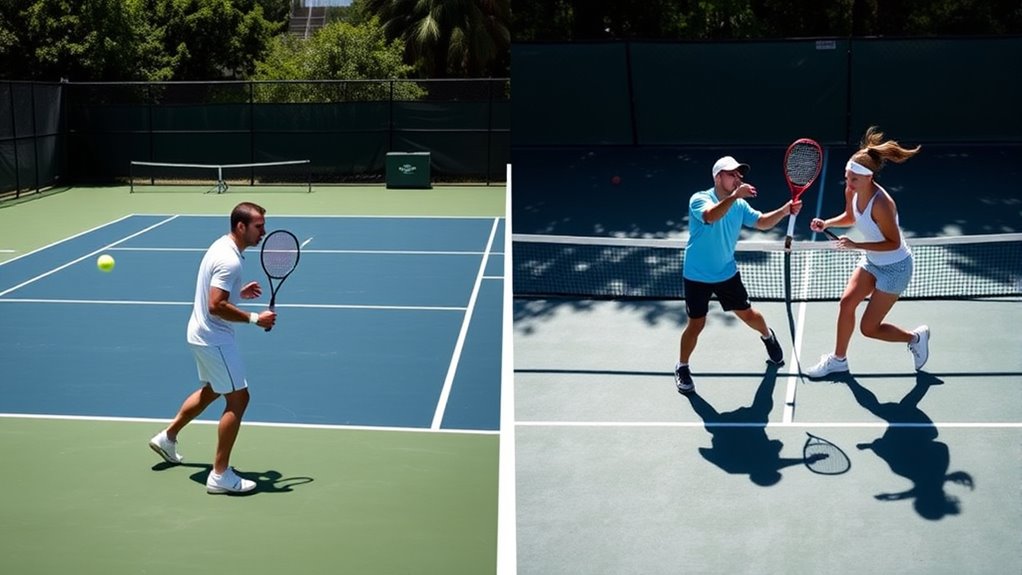

When you play tennis, singles and doubles require different strategies. In singles, you cover the entire court and rely on your instincts, while doubles focuses on teamwork and communication with your partner. Positioning plays a vital role in doubles, influenced by your partner’s moves, whereas singles emphasizes creating angles to exploit weaknesses. Both formats contribute to your overall skill development and present unique challenges. Discover more about these strategic nuances and how they can enhance your game.
Key Takeaways
- Singles players must independently cover the entire court, focusing on personal agility and shot anticipation.
- Doubles requires strategic positioning and communication with a partner to optimize court coverage and shot selection.
- In singles, players focus on creating angles and exploiting opponents’ weaknesses, while doubles emphasizes coordinated attacks with a partner.
- Effective communication in doubles includes signals and cues, enhancing coordination and positioning during crucial moments in the match.
- The choice between singles and doubles impacts skill development; singles fosters self-reliance, whereas doubles encourages teamwork and collaboration.
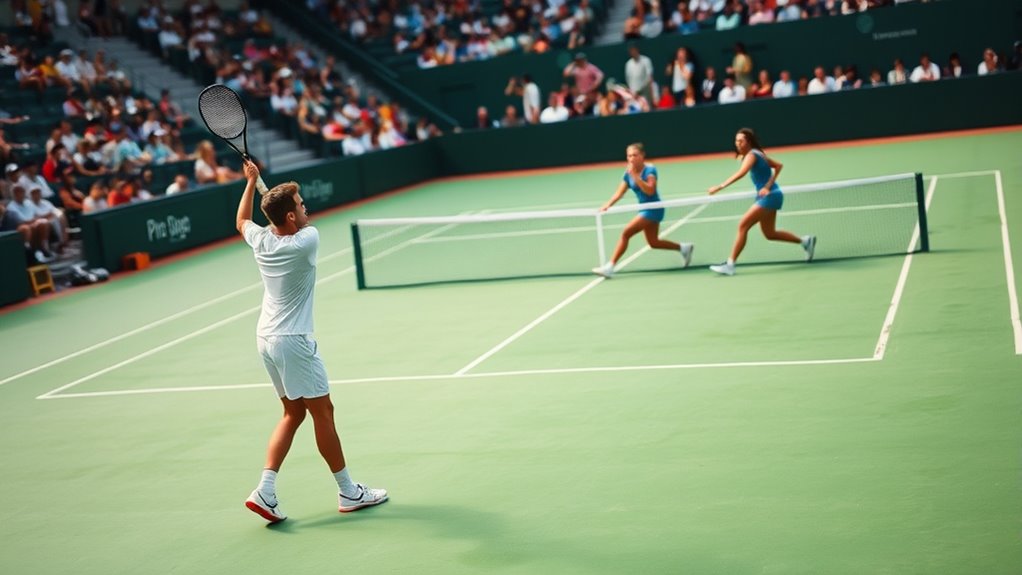
Whether you’re a casual player or a seasoned pro, choosing between tennis singles and doubles can considerably impact your game experience. The strategies you employ will differ markedly, particularly in areas like court positioning and communication tactics. In singles, you’re solely responsible for covering the entire court. This demands a keen awareness of your opponent’s movements and a solid understanding of where to position yourself to anticipate their shots. You’ll need to be agile, ready to shift your positioning based on the ball’s trajectory. Your ability to read the game plays a vital role; you’ll rely on your instincts and skills to navigate the court effectively.
On the other hand, when you step onto the court for doubles, you’ll find that the dynamics change dramatically. You’ve got a partner by your side, which means your positioning becomes more strategic. It’s not just about where you stand; it’s about how you and your partner can work together to cover the court efficiently. You’ll need to communicate effectively to guarantee you’re both in the right spots at the right times. This is where communication tactics come into play. You might use signals, verbal cues, or even eye contact to coordinate your movements. Successful doubles teams thrive on this synergy, allowing you to capitalize on each other’s strengths.
The server’s positioning in doubles is also vital. Your partner’s positioning can influence your serve strategy. You might choose to serve wide to open up the court while your partner covers the net, ready to put away any weak returns. In singles, however, you’re more likely to focus on creating angles that exploit your opponent’s weaknesses. You want to pull them side to side, keeping them off balance and creating opportunities to finish points.
Ultimately, the choice between singles and doubles isn’t just about personal preference; it’s about how you want to engage with the game. If you enjoy the challenge of solo play and the need for self-reliance, singles might be your calling. If you thrive in a teamwork environment, doubles can enhance your enjoyment and sharpen your skills. Each format offers its own set of strategic nuances, making every match an opportunity to learn and grow as a player. Embrace the differences and find what resonates most with you on the court. Additionally, understanding the role of communication tactics can significantly improve your performance in doubles matches.

The Art of Winning Doubles Tennis: 8 Keys for Beginner or Pro: Practical Tips, Strategic Positioning, and Mental Toughness for Recreational and Competitive Team Training
As an affiliate, we earn on qualifying purchases.
As an affiliate, we earn on qualifying purchases.
Frequently Asked Questions
How Do Scoring Systems Differ in Singles and Doubles Tennis?
In tennis, scoring systems for singles and doubles have some key differences. In singles, you play for every point, while in doubles, the court’s wider dimensions lead to different point allocation strategies. Scoring variation can also arise from team dynamics; for example, communication and positioning can influence how points are won. You’ll need to adapt your approach based on these scoring differences to maximize your performance in either format.
What Are the Physical Demands of Singles Versus Doubles Tennis?
When you’re facing off against an opponent, think of it like a marathon versus a relay. Singles tennis demands high cardio endurance since you’re covering the entire court, while doubles lets you conserve energy by sharing the load. You’ll also need muscular strength in singles to power through each shot, but in doubles, quick reflexes and teamwork take center stage. Each format tests your fitness in unique ways, pushing you to excel.
Can You Play Singles and Doubles in the Same Tournament?
Yes, you can play singles and doubles in the same tournament, showcasing your tournament flexibility and player versatility. Many events allow players to compete in both formats, provided you’re up for the physical demands of each. Balancing your time and energy is essential, though. If you manage your matches well, you’ll gain valuable experience and improve your overall game. Just be sure to stay hydrated and rest between matches for peak performance!
How Does Court Size Affect Singles and Doubles Play?
Court size is vital to your play style in singles and doubles. In singles, you utilize the full court dimensions, allowing for longer rallies and strategic shot placement. In doubles, the court becomes more compact, and you focus on quick exchanges and positioning. The net height remains the same, but the dynamics change; teamwork becomes essential in doubles, while singles requires more individual strategy to cover the larger area effectively.
What Are the Most Common Injuries in Singles Versus Doubles Tennis?
Injuries in tennis can be alarming; around 50% of players experience them each year. In singles, you’re more prone to overuse injuries like shoulder or elbow issues due to constant high-impact movements. Doubles players often face ankle sprains or muscle strains from quick lateral movements. Focusing on injury prevention and player conditioning can considerably reduce these risks. Staying fit and incorporating strength training will help you enjoy the game longer, regardless of your format!

OnCourt OffCourt Serve Doctor – Improve Your Tennis Serve/Tennis Training Aid
SERVE TRAINER: Tennis serve trainer assists beginners to learn proper swings in isolation
As an affiliate, we earn on qualifying purchases.
As an affiliate, we earn on qualifying purchases.
Conclusion
In the world of tennis, singles is like a lone wolf, relying on personal skill and strategy, while doubles is a well-oiled machine, each player a cog working in harmony. The court transforms from a vast battlefield to a dynamic dance floor, where teamwork reigns supreme. Whether you prefer the solitary challenge or the collaborative effort, both formats shape your game. Embrace the unique rhythm of each, and let the sport illuminate your strengths, revealing the true essence of competition.

ADV Training Kit V2: Tennis Trainer Equipment for Tennis Training, Practice & Drills – Includes Counting Jump Rope, Resistance Bands, Stretch Bands for Exercise, Tennis Trainer Rebound Ball & Cones
COMPREHENSIVE TENNIS TRAINING KIT: Curated to maximize the potential of tennis players by enhancing balance, strength, speed, agility,…
As an affiliate, we earn on qualifying purchases.
As an affiliate, we earn on qualifying purchases.

Wilson Hyper Power Tennis Racquet (4 3/8" Grip) Doubles Bundle with an Advantage 2.5 Bag or Backpack
INCLUDED IN THIS BUNDLE: This recreational doubles tennis set includes (2) Wilson Hyper Power Tennis Racquets and (1)…
As an affiliate, we earn on qualifying purchases.
As an affiliate, we earn on qualifying purchases.