
TL;DR

Get workout gear delivered free with Prime
- Fast, free delivery on millions of items
- Prime Video, Amazon Music and more included
- Member-only deals all year
Personal trainer Pippa Sealey recommends shorter rest periods and unilateral movements to make home dumbbell workouts more challenging without buying heavier weights. A Fit&Well report outlines a workout using supersets and tri-sets, but it is aimed at people already comfortable with basic lifts.
Personal trainer Pippa Sealey recommends two ways to make home dumbbell workouts more challenging when the weights available are too light to support continued progress: shorter rest periods and unilateral movements, which work one side of the body at a time. Fit&Well’s report pairs those methods in a workout for people already confident with basic movements such as squats and deadlifts.
Sealey told Fit&Well that shorter rests and one-sided exercises can help people keep training without access to heavier loads. A unilateral exercise, such as a single-leg Romanian deadlift or a split squat, places the work on one side at a time; bilateral movements use both sides together. The report presents these as ways to increase a workout’s challenge, not as a guarantee of continued strength gains.
The workout is organized into supersets and tri-sets. A superset pairs two exercises: complete one set of the first, then one set of the second before resting. A tri-set adds a third exercise to the sequence. The report says to complete each sequence three times before moving on. It lists calf raises, hamstring bridge marches and wall sits in the first tri-set, followed by a single-leg Romanian deadlift and split squat.
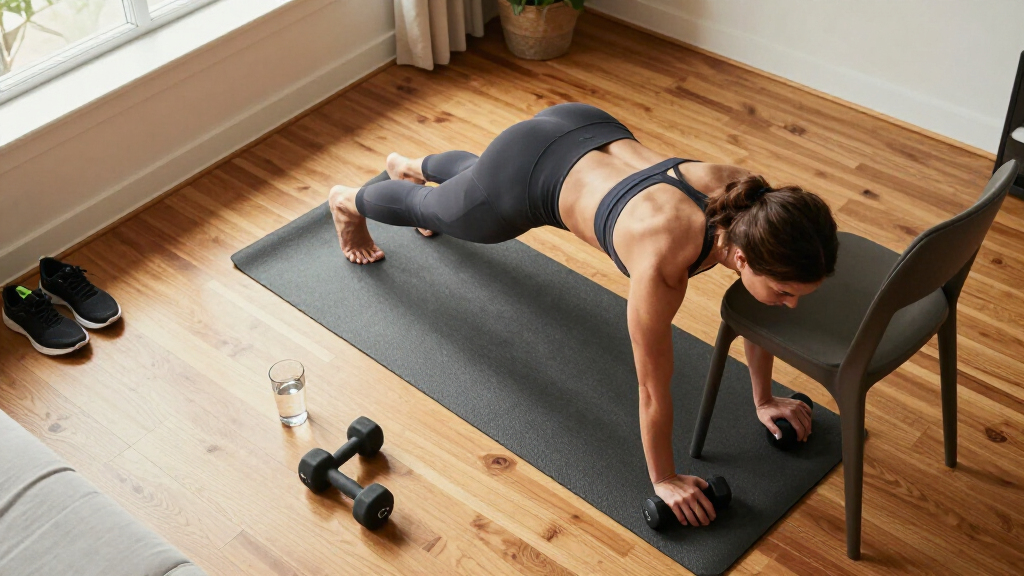
Later groups include push-ups and a single-arm dumbbell row, then core exercises such as side-plank hip lifts and plank dumbbell pull-throughs. In the provided plan, some paired exercises have no rest between them, while the wall sit and split squat sections specify 60–90 seconds of rest after the sequence. The push-up instruction is to do as many repetitions as possible while maintaining good form.
Making Limited Home Weights Work Harder
For people training at home with a fixed pair of dumbbells, Sealey’s approach offers options that do not depend on buying a heavier set. Shorter recovery periods change the workout’s pace, while one-sided movements can make a given load feel more demanding than using it in a two-sided exercise. That can be useful when equipment choices are limited.
The advice is specific to workout design, not proof that these methods are superior to progressively increasing weight. The Fit&Well report does not provide research findings or outcome data showing how much the workout improves strength. Readers can treat the routine as one trainer’s suggested format, with the amount of challenge depending on their ability, available weights and technique.
Products Worth Considering

BowFlex Results Series SelectTech 552 Adjustable Dumbbell

BowFlex Results Series SelectTech Dumbbells

Fitbit Versa 2 Health and Fitness Smartwatch with Bonus Bands
As an affiliate, we earn on qualifying purchases.
The Workout’s Intended Audience
The report frames the routine for people who are already confident with fundamental movements, including squats and deadlifts, and want a more demanding session. Its exercises include balance-dependent single-leg work, pressing movements and timed holds. That makes familiarity with the movements relevant before attempting the full sequence.
Supersets and tri-sets reduce the pause between exercises within a group, but the plan still includes recovery periods after some groups. It does not call for eliminating all rest. The distinction matters: Sealey’s suggestion is to use shorter rests as a training tool, while the workout’s written instructions retain rest where specified.
“You may also want to use more agonist supersets.”
— Pippa Sealey, as reported by Fit&Well
Limits of the Available Workout Details
The source does not give a publication date, explain how Sealey’s recommendations were tested, or report measured results from people using the workout. It also does not specify how readers should choose dumbbell weights or adjust the routine to different training levels. The supplied workout text ends partway through the instructions for the single-arm dumbbell push press, so the complete exercise guidance and any final training notes are not available here.
It is also unclear how often the routine is intended to be performed or how it should be progressed over time. The report’s general advice should not be read as a substitute for individualized coaching, particularly for people new to strength training or managing an injury or health condition.
How Readers Can Apply the Advice
Readers considering the routine can first check the full Fit&Well report for its complete exercise instructions, especially for movements whose guidance is not fully included in the available source text. The routine should be approached at a level that allows controlled, technically sound repetitions; the push-up section itself specifies stopping when good form can no longer be maintained.
No follow-up study, new training program or further announcement is identified in the source. For now, the confirmed development is the publication of Sealey’s workout and her advice on rest periods and unilateral exercises. Anyone unsure about safe technique or appropriate exercise selection can seek guidance from a qualified fitness professional.
Key Questions
What are the two methods Pippa Sealey recommends?
Sealey recommends shorter rest periods and unilateral exercises, which train one side of the body at a time, for home workouts when heavier weights are unavailable.
What is a superset in this workout?
A superset means completing one set of an exercise and then moving directly to a set of a second exercise before resting. A tri-set follows the same pattern with three exercises.
Who is the workout intended for?
The Fit&Well report says it is designed for people who are already comfortable with basic movements such as squats and deadlifts and want to increase the challenge of their training.
Does the report show that the workout produces specific strength gains?
No. The report shares Sealey’s training advice and a sample routine, but it does not provide measured results or evidence quantifying strength gains.
Source: rss