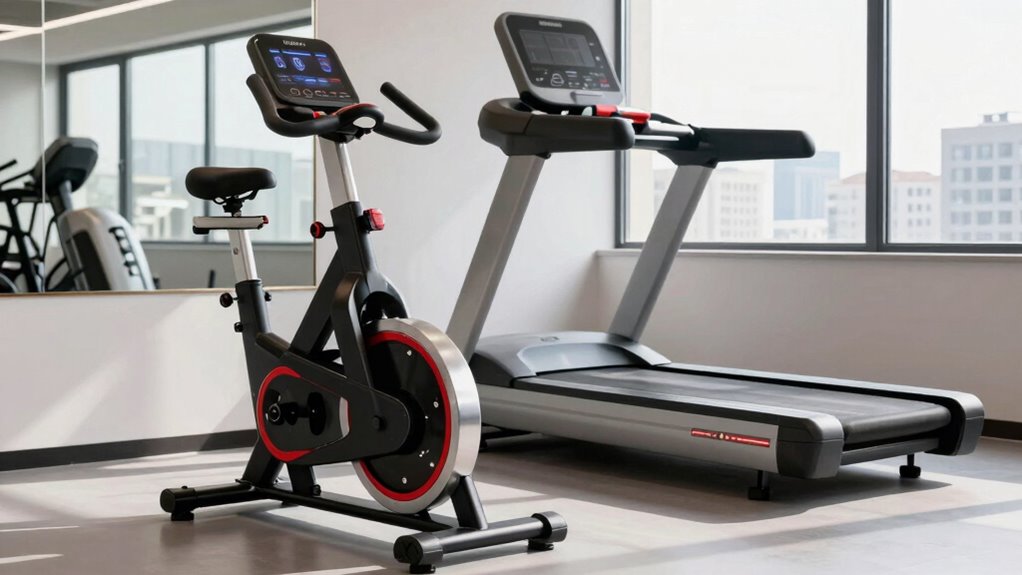

If you’re choosing between a stationary bike and a treadmill, consider your fitness goals and joint health. The treadmill offers a high-impact workout that boosts cardiovascular health and mimics outdoor running, but can stress your joints. The stationary bike provides a low-impact option that’s gentler on your knees and hips while still offering effective cardio and muscle engagement. To find the best fit for your needs and discover how to optimize your workout, keep exploring your options.

Get workout gear delivered free — and shop member deals
- Fast, free delivery on millions of items
- Access to Prime Big Deal Days deals on October 6–7
- Prime Video, Amazon Music and more included
Key Takeaways
- Treadmills offer higher-intensity, weight-bearing workouts that boost cardiovascular health but have greater joint impact.
- Stationary bikes provide low-impact, joint-friendly exercise ideal for those with joint pain or arthritis.
- Treadmills better simulate outdoor running with versatile incline options for increased challenge.
- Bikes allow precise resistance control, targeting specific muscle groups and supporting endurance training.
- Both options support effective cardio, but choosing depends on joint health, workout preferences, and fitness goals.

When choosing between a stationary bike and a treadmill for your fitness routine, it’s important to take into account your goals, preferences, and physical condition. Both options offer effective workouts, but they differ in how they impact your body and the type of training you can do. If you’re interested in improving cardiovascular health, burning calories, or building endurance, understanding these differences can help you make the best choice. For instance, if you prefer high-intensity workouts, interval training on a treadmill can be very effective because it allows you to alternate between sprints and recovery periods. This type of training boosts your metabolism and challenges your cardiovascular system efficiently. On the other hand, a stationary bike can also support interval training, but it’s typically easier on your joints, making it suitable for those with joint issues or arthritis. Additionally, the joint impact of each equipment is a key consideration when choosing your workout method. Treadmills involve running or walking, which can put significant stress on your knees, hips, and ankles. If you’re prone to joint pain or recovering from an injury, the higher joint impact of treadmill workouts might not be ideal. Conversely, a stationary bike provides a low-impact alternative, allowing you to get a solid cardiovascular workout without stressing your joints as much. This makes it a preferred choice for many people with joint concerns or those who want to avoid injury. Your preference for workout style also plays a role. Treadmills simulate outdoor running or walking, which can be more engaging if you enjoy the feeling of outdoor exercise. You can also increase the challenge by adjusting incline levels, simulating hill climbs, and adding speed intervals. The bike, however, offers a more controlled environment, often with adjustable resistance that allows you to target specific muscle groups like your quads, hamstrings, and calves. Plus, many stationary bikes come with built-in programs that facilitate interval training, helping you switch between high-intensity sprints and recovery periods seamlessly. Moreover, understanding the neurobiological effects of each exercise can help you tailor your workout to enhance mental health benefits alongside physical fitness. Incorporating muscle engagement through resistance settings can further optimize your workout outcomes. Considering the long-term benefits of each workout type can also guide your decision, as consistency and enjoyment are key to maintaining a healthy routine. Ultimately, the better workout depends on what you’re aiming for. If you want a high-impact, versatile workout that mimics outdoor running, a treadmill might suit you best. If you prefer a low-impact, joint-friendly workout that still burns calories and improves endurance, a stationary bike could be the better choice. Both can be integrated into a balanced fitness routine, but understanding their differences helps you align your workouts with your goals and physical needs.
stationary bike with adjustable resistance
As an affiliate, we earn on qualifying purchases.
As an affiliate, we earn on qualifying purchases.
Frequently Asked Questions
Which Equipment Burns More Calories per Hour?
The treadmill burns more calories per hour than a stationary bike, making it more calorie-efficient for weight loss. During high-intensity running, you can burn up to 600-900 calories per hour, while biking typically burns around 400-700 calories. Your exercise efficiency depends on effort and intensity, but overall, the treadmill’s higher calorie comparison makes it a better choice if your goal is maximum calorie burn.
Can Either Machine Improve Bone Density?
Yes, both machines can improve bone density through bone strengthening exercises, but they differ in joint impact. The stationary bike offers low-impact workouts, making it ideal if you’re concerned about joint stress, helping improve bone density gradually. The treadmill involves higher joint impact, which can stimulate bone growth more effectively but may increase wear on joints. Choose based on your joint health and fitness goals.
Are There Specific Health Conditions Better Suited for One?
If you have joint problems, the stationary bike is your superhero, dramatically reducing joint impact while boosting cardiovascular health without the pounding on your knees or hips. Conversely, if you’re recovering from certain injuries or need weight-bearing exercise, the treadmill might be better suited. Always consult your doctor, but for high-impact concerns, the bike is often the safer, gentler champion for protecting your joints and improving heart health.
How Do Cost and Maintenance Compare Long-Term?
You’ll find that stationary bikes generally have a lower cost comparison and maintenance expenses than treadmills. Bikes are usually cheaper upfront and require less upkeep, as they have fewer moving parts and less wear and tear. Treadmills tend to be more expensive initially and may need more frequent repairs or belt replacements over time. So, if budget and ease of maintenance are priorities, a stationary bike could be the smarter long-term choice.
Which Is More Suitable for Seniors or Rehabilitation?
For seniors or rehabilitation, a stationary bike is typically more suitable because it offers a low-impact exercise and a joint-friendly workout. You can pedal at your own pace without stressing your knees or hips, making it safer and more comfortable during recovery. The bike minimizes strain, helping improve cardiovascular health and muscle strength gradually. Overall, it’s an excellent choice for gentle, effective exercise tailored to your needs.
treadmill with incline and speed settings
As an affiliate, we earn on qualifying purchases.
As an affiliate, we earn on qualifying purchases.
Conclusion
Ultimately, choosing between a stationary bike and a treadmill is like picking your favorite song—each has its own rhythm and soul. The bike offers a smooth, steady dance that’s gentle on your joints, while the treadmill invites you to sprint towards your goals with relentless energy. Whichever path you choose, let it ignite your spirit and propel you forward. Remember, the journey is yours—make it a vibrant voyage toward a healthier, happier you.
low impact exercise bike for joint pain
As an affiliate, we earn on qualifying purchases.
As an affiliate, we earn on qualifying purchases.
As an affiliate, we earn on qualifying purchases.
Fall Picks
fall essentials
As an affiliate, we earn on qualifying purchases.