The best cycling computer for most riders is the Garmin Edge 850 Compact GPS Cycling Computer, which balances a small footprint with a touchscreen interface and capable ride tools. For a simpler Garmin setup, the Edge 540 favors button controls, while the Wahoo ELEMNT BOLT V3 is a strong alternative for riders who want a compact, streamlined display. The main tradeoffs are screen size versus handlebar space, advanced navigation versus ease of use, and premium features versus a simpler setup. Battery demands, sensor compatibility, and how you plan routes also shape the right choice. Read on for a full comparison of all 14 cycling computers and guidance on which type of rider each suits.

Get workout gear delivered free with Prime
- Fast, free delivery on millions of items
- Prime Video, Amazon Music and more included
- Member-only deals all year
Complete the kit



Key Takeaways
- The Garmin Edge 850 is the strongest all-round fit in this lineup for riders who want a compact computer with a touchscreen, while the button-led Edge 540 makes more sense if tactile control matters more than touch.
- Garmin dominates the feature-rich choices, but the Wahoo ELEMNT BOLT V3 offers a distinct compact alternative for riders who prefer a streamlined setup over a large screen.
- Large-screen models serve different needs: the Edge 1040 and 1050 families suit riders who value a broad display, while compact models leave more room on crowded handlebars.
- The less expensive-feeling alternatives are not interchangeable: the iGPSPORT BSC100S prioritizes simplicity, while the BSC500 and GEOID CC700 Pro add touchscreen and navigation features.
- Bundles change what comes in the box, not the computer’s core role. Compare the Edge 540 and 1050 bundles with their standalone counterparts based on included accessories and protection, not on an assumed performance upgrade.
| Garmin Edge 850 Compact GPS Cycling Computer |  | Best for Mixed-Surface Navigation | Screen: 2.7-inch LCD color touchscreen | Controls: Touchscreen and buttons | Battery life: Up to 12 hours; up to 36 hours in battery saver mode | VIEW LATEST PRICE | See Our Full Breakdown |
| Garmin Edge 540 GPS Cycling Computer |  | Best for Long Training Rides | Screen: 2.6-inch LCD | Resolution: 246 x 322 | Controls: Buttons | VIEW LATEST PRICE | See Our Full Breakdown |
| Garmin Edge 540 GPS Cycling Computer Bundle with Bike Frame Mount and Extended Protection |  | Best Edge 540 Accessory Bundle | Model: Garmin Edge 540 | Screen: 2.6-inch transflective TFT | Controls: Buttons | VIEW LATEST PRICE | See Our Full Breakdown |
| iGPSPORT BSC100S Wireless GPS Bike Computer with 2.6-Inch LCD |  | Best for Straightforward Sensor Tracking | Display: 2.6-inch LCD | Controls: 2 buttons | Battery life: Up to 40 hours | VIEW LATEST PRICE | See Our Full Breakdown |
| Garmin Edge 850 GPS Cycling Computer with 2.7-Inch Touchscreen |  | Best Accessory-Rich Premium Pick | Display: 2.7-inch color touchscreen | Controls: Buttons and touchscreen | Battery life: Up to 12 hours; up to 36 hours in battery saver mode | VIEW LATEST PRICE | See Our Full Breakdown |
| iGPSPORT BSC500 GPS Bike Computer with 3.3-Inch Touchscreen and Voice Navigation |  | Best for App-Assisted Navigation | Display size: 3.3 inches | Controls: Touchscreen and buttons | Data display: Up to 12 cycling data points per page | VIEW LATEST PRICE | See Our Full Breakdown |
| Garmin Edge 1040 Solar GPS Bike Computer |  | Best for Long-Distance Rides | Display: 3.5-inch LCD | Native resolution: 282 x 470 | Battery life: 30 hours average; up to 100 hours in battery-saver mode with solar charging | VIEW LATEST PRICE | See Our Full Breakdown |
| GEOID CC700 Pro GPS Bike Computer with 2.8-Inch Color Touchscreen |  | Best for Offline Maps and Indoor Training | Display: 2.8-inch color TFT touchscreen | Controls: Touchscreen and three buttons | Connectivity: ANT+, Bluetooth, Wi-Fi | VIEW LATEST PRICE | See Our Full Breakdown |
| Garmin Edge 1050 Premium Cycling Computer |  | Best Premium Feature Set | Screen: 3.5-inch capacitive LCD touchscreen | Battery life: Up to 20 hours in demanding use; up to 60 hours in battery-saver mode | Storage: 64 GB | VIEW LATEST PRICE | See Our Full Breakdown |
| Wahoo ELEMNT BOLT V3 Aero GPS Bike Computer |  | Best Compact Button-Operated Computer | Display: 2.3-inch, 64-color LCD | Controls: Buttons | Battery life: Up to 20 hours | VIEW LATEST PRICE | See Our Full Breakdown |
| CYCPLUS G1 Wireless GPS Bike Computer | 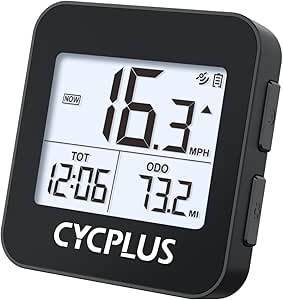 | Best Simple GPS Pick | Display: 2-inch FSTN | Battery capacity: 1200 mAh lithium polymer | Battery life: 50 hours average; over 55 hours stated | VIEW LATEST PRICE | See Our Full Breakdown |
| Garmin Edge 840 GPS Cycling Computer |  | Best for Training and Navigation | Display: 2.6-inch LCD, 240 x 320 resolution | Controls: Buttons and capacitive touchscreen | Satellite navigation: GPS with multi-band GNSS support | VIEW LATEST PRICE | See Our Full Breakdown |
| Garmin Edge 1050 Premium Cycling Computer Bundle with Accessories |  | Best Premium Screen and Bundle | Display: 3.5-inch LCD color touchscreen | Controls: Buttons and touchscreen | Navigation: GPS | VIEW LATEST PRICE | See Our Full Breakdown |
| Garmin Edge 1040 GPS Bike Computer |  | Best for Long-Distance and Sensor-Rich Training | Display: 3.5-inch color touchscreen | Battery life: Up to 35 hours standard; up to 70 hours in battery saver mode | Battery type: Lithium polymer | VIEW LATEST PRICE | See Our Full Breakdown |
| cycling computer | Controls | Battery life | Connectivity | Weight |
|---|---|---|---|---|
| Garmin Edge 850 Compact GPS Cy | Touchscreen and buttons | Up to 12 hours; up to 36 hours in battery saver mode | Bluetooth, USB, Wi-Fi | 3.9 ounces |
| Garmin Edge 540 GPS Cycling Co | Buttons | Up to 26 hours; up to 42 hours in battery saver mode | Bluetooth, Wi-Fi, USB | 2.8 ounces |
| Garmin Edge 540 GPS Cycling Co | Buttons | Up to 42 hours | Bluetooth, Wi-Fi | 2.88 ounces |
| iGPSPORT BSC100S Wireless GPS | 2 buttons | Up to 40 hours | Bluetooth 5.0, ANT+ | — |
| Garmin Edge 850 GPS Cycling Co | Buttons and touchscreen | Up to 12 hours; up to 36 hours in battery saver mode | — | — |
| iGPSPORT BSC500 GPS Bike Compu | Touchscreen and buttons | — | — | 107 g |
| Garmin Edge 1040 Solar GPS Bik | Buttons and touchscreen | 30 hours average; up to 100 hours in battery-saver mode with solar charging | Bluetooth, USB | 4.7 ounces |
| GEOID CC700 Pro GPS Bike Compu | Touchscreen and three buttons | — | ANT+, Bluetooth, Wi-Fi | 0.22 kg |
| Garmin Edge 1050 Premium Cycli | — | Up to 20 hours in demanding use; up to 60 hours in battery-saver mode | Bluetooth, USB, Wi-Fi | 5.7 ounces |
| Wahoo ELEMNT BOLT V3 Aero GPS | Buttons | Up to 20 hours | Bluetooth, ANT+, Wi-Fi, USB-C | 84 g |
| CYCPLUS G1 Wireless GPS Bike C | Buttons | 50 hours average; over 55 hours stated | Wireless GPS | 70 g |
| Garmin Edge 840 GPS Cycling Co | Buttons and capacitive touchscreen | Up to 26 hours; up to 32 hours in battery saver mode | Bluetooth, USB, and Wi-Fi | — |
| Garmin Edge 1050 Premium Cycli | Buttons and touchscreen | Up to 20 hours in demanding use; up to 60 hours in battery saver mode | Bluetooth and Wi-Fi | 5.7 ounces |
| Garmin Edge 1040 GPS Bike Comp | — | Up to 35 hours standard; up to 70 hours in battery saver mode | Bluetooth and USB | 4.4 ounces |
More Details on Our Top Picks
Garmin Edge 850 Compact GPS Cycling Computer
The Edge 850 is the strongest fit here for riders who move between pavement, gravel, and trails and want maps they can follow on the unit. Its 2.7-inch color touchscreen plus physical buttons gives you a choice of input, while the built-in speaker can provide prompts and a bike-bell function. Compared with the button-only Edge 540, the 850 offers a more direct map interaction and broader preloaded terrain maps, but its demanding-use battery life is shorter: up to 12 hours versus the 540’s 26. The battery saver mode stretches the 850 to 36 hours, though the 540 still has the longer stated maximum. Some connected ride tools need a phone, and smart fueling alerts require compatible sensors, so this is best for map-focused riders rather than buyers seeking a fully self-contained training setup.
Pros:- Preloaded road, gravel, and trail maps support varied route planning.
- Touchscreen and buttons offer flexible control.
- Built-in speaker provides navigation and workout prompts plus a bike-bell function.
- Battery saver mode extends stated battery life to 36 hours.
Cons:- Up to 12 hours in demanding use is shorter than the Edge 540’s stated 26 hours.
- Some connected features require a compatible smartphone and Garmin Connect.
- Smart fueling alerts require a compatible power meter and heart rate monitor.
Best for: Road, gravel, and trail riders who want a compact Garmin with touch-friendly mapping and physical controls.
Not ideal for: Riders prioritizing long demanding rides between charges or those who want fueling guidance without compatible sensors.
- Screen:2.7-inch LCD color touchscreen
- Controls:Touchscreen and buttons
- Battery life:Up to 12 hours; up to 36 hours in battery saver mode
- Connectivity:Bluetooth, USB, Wi-Fi
- Satellite systems:GPS, GLONASS, Galileo
- Maps:Preloaded road, gravel, and trail maps
- Weight:3.9 ounces
- Dimensions:0.7 x 2.1 x 3.6 inches
Our verdict“Choose the Edge 850 if map interaction across road, gravel, and trails matters more to you than the Edge 540’s longer demanding-use battery life.”
Garmin Edge 540 GPS Cycling Computer
The Edge 540 earns its place for riders who value long battery life and button control over touchscreen convenience. It runs for up to 26 hours in demanding use and up to 42 hours in battery saver mode, making it better suited to extended training days than the Edge 850, whose demanding-use figure is 12 hours. Multi-band GNSS, ride-specific maps, and ClimbPro add useful guidance when routes include climbs or less familiar roads. The tradeoff is a smaller 2.6-inch display operated entirely by buttons, which is less direct for map interaction than the Edge 850’s touchscreen. Its listed map coverage is North America, and several coaching insights depend on compatible sensors. I’d favor this model for training-focused riders who want dependable physical controls and endurance, not riders seeking touch-based navigation.
Pros:- Up to 26 hours of battery life in demanding use and 42 hours in battery saver mode.
- Multi-band GNSS supports enhanced positioning accuracy.
- Button controls suit operation in varied riding conditions.
- ClimbPro and ride-specific maps add route and ascent guidance.
Cons:- No touchscreen for direct map interaction.
- Listed map coverage is North America.
- Several coaching and performance features require a compatible power meter and heart rate monitor.
Best for: Training-focused road cyclists who ride long days, prefer physical buttons, and can pair compatible sensors for added performance data.
Not ideal for: Riders who want touchscreen map interaction, broad preloaded terrain maps, or map coverage beyond the listed North America region.
- Screen:2.6-inch LCD
- Resolution:246 x 322
- Controls:Buttons
- Battery life:Up to 26 hours; up to 42 hours in battery saver mode
- Storage:16 GB
- Connectivity:Bluetooth, Wi-Fi, USB
- Map coverage:North America
- Weight:2.8 ounces
Our verdict“Pick the Edge 540 for long training rides and button-first operation; choose the Edge 850 instead if touchscreen mapping is a higher priority.”
Garmin Edge 540 GPS Cycling Computer Bundle with Bike Frame Mount and Extended Protection
This bundle suits buyers who already want the button-controlled Edge 540 and would rather receive extra mounting gear in the same package. It includes standard and out-front mounts, a phone mount for the bike frame, and a 26-month extended protection plan, alongside the computer’s adaptive coaching, stamina insights, ClimbPro, and multi-band GNSS. Compared with the standalone Edge 540, the main distinction is the added accessories and protection—not a different computer or expanded navigation system. Its stated battery life reaches 42 hours, a useful match for long training days, while the 2.6-inch screen and button-only controls remain less convenient for touch-based map browsing than the Edge 850. Sensor-dependent performance features may also require separate compatible hardware. I’d choose this package when the included mounts and coverage fit your setup, not just for a different riding experience.
Pros:- Includes standard and out-front mounts plus a bike-frame phone mount.
- Includes a 26-month extended protection plan.
- Up to 42 hours of stated battery life supports long rides.
- Multi-band GNSS, ClimbPro, adaptive coaching, and stamina insights support training.
Cons:- Button-only controls do not offer touchscreen map interaction.
- Compatible sensors may be needed for some performance features.
- The computer itself shares the Edge 540’s core design rather than adding a distinct navigation feature.
Best for: Edge 540 buyers who need multiple mounting options, a bike-frame phone mount, and the included extended protection plan.
Not ideal for: Riders who already own suitable mounts or prefer a touchscreen cycling computer such as the Edge 850.
- Model:Garmin Edge 540
- Screen:2.6-inch transflective TFT
- Controls:Buttons
- Battery life:Up to 42 hours
- Storage:16 GB
- Connectivity:Bluetooth, Wi-Fi
- Satellite navigation:GPS, GLONASS, Galileo
- Included:Standard and out-front mounts, bike-frame phone mount, 26-month extended protection plan
- Weight:2.88 ounces
Our verdict“Choose this bundle if you need its extra mounts and extended protection; otherwise, the standalone Edge 540 offers the same core computer experience.”
iGPSPORT BSC100S Wireless GPS Bike Computer with 2.6-Inch LCD
The iGPSPORT BSC100S is the practical choice for riders who want a broad set of ride metrics and sensor compatibility without stepping up to a Garmin training computer. It tracks more than 40 metrics, supports Bluetooth and ANT+ sensors, and can share ride data through the iGPSPORT app with Strava and Komoot. Its IPX7 water resistance, anti-glare 2.6-inch display, and stated 40-hour battery life make it a sensible fit for long outings. Compared with the Edge 540, it offers a longer stated battery figure but does not list Garmin’s ClimbPro or adaptive coaching tools. The two-button interface is simple, though it lacks touchscreen map interaction, and the product data gives conflicting weights of 67 g and 120 g. The USB-C charging cable is also not included.
Pros:- Tracks more than 40 riding metrics and supports automatic functions such as auto-pause.
- Bluetooth 5.0 and ANT+ support a range of compatible sensors.
- IPX7 water resistance and an anti-glare 2.6-inch display suit varied riding conditions.
- Stated battery life is up to 40 hours.
Cons:- Two-button controls do not provide touchscreen map interaction.
- The listed weight conflicts between 67 g and 120 g.
- USB Type-C charging cable is not included.
Best for: Riders seeking long battery life, basic ride-data tracking, and Bluetooth or ANT+ sensor pairing with app-based sharing.
Not ideal for: Cyclists who want detailed built-in route guidance, a touchscreen, or consistent published weight information.
- Display:2.6-inch LCD
- Controls:2 buttons
- Battery life:Up to 40 hours
- Water resistance:IPX7
- Connectivity:Bluetooth 5.0, ANT+
- Satellite systems:GPS, BeiDou, GLONASS, Galileo, QZSS
- Riding data:More than 40 metrics
- Charging port:USB Type-C
- Data storage:8 MB / 250 hours
Our verdict“Choose the BSC100S for long-lasting sensor-based ride tracking, but pick the Edge 540 if you want its listed ClimbPro and adaptive coaching features.”
Garmin Edge 850 GPS Cycling Computer with 2.7-Inch Touchscreen
This Edge 850 package pairs a color touchscreen and physical buttons with preloaded bike maps, turn-by-turn navigation, and training tools such as stamina, power guidance, and ClimbPro. Road hazard alerts, GroupRide messaging, and a built-in bike bell add ride-focused functions beyond basic recording. The included power bank, wall charger, cleaning kit, and USB-A to USB-C cable give it a broader accessory set than the other Edge 850 listing, which describes the computer without this kit. The core battery limitation remains: up to 12 hours in demanding use, or 36 hours in battery saver mode. That is less demanding-use endurance than the Edge 540’s stated 26 hours. Some performance insights need compatible sensors, so this package suits riders who value its navigation and included accessories more than maximum battery life.
Pros:- Combines touchscreen and physical buttons for flexible operation.
- Preloaded bike maps, turn-by-turn navigation, and Trailforks MTB data support varied riding.
- Training tools include stamina, power guidance, and ClimbPro.
- Package includes a power bank, wall charger, cleaning kit, and USB-A to USB-C cable.
Cons:- Demanding-use battery life is up to 12 hours, shorter than the Edge 540’s stated 26 hours.
- Some performance insights require compatible sensors.
- The listed item weight is 1.3 pounds.
Best for: Road, gravel, and mountain riders who want Garmin’s touchscreen navigation and training tools with a power bank and charging accessories included.
Not ideal for: Long-distance riders who need more than 12 hours in demanding use, or buyers who do not need the bundled accessories.
- Display:2.7-inch color touchscreen
- Controls:Buttons and touchscreen
- Battery life:Up to 12 hours; up to 36 hours in battery saver mode
- GPS recording:Multi-band GPS; 5 Hz recording
- Mounting:Handlebar mount
- Included accessories:Cleaning kit, USB wall charger, power bank, USB-A to USB-C cable
- Navigation:Preloaded bike maps, turn-by-turn navigation, Trailforks MTB data
- Item weight:1.3 pounds
Our verdict“Choose this Edge 850 package if its touchscreen navigation and included power bank suit your rides, but favor the Edge 540 for longer demanding-use battery life.”
iGPSPORT BSC500 GPS Bike Computer with 3.3-Inch Touchscreen and Voice Navigation
The iGPSPORT BSC500 is a strong fit for riders who want a large, flexible display without stepping up to Garmin’s pricier feature-rich computers. Its 3.3-inch touchscreen plus physical buttons gives riders a choice of controls, while showing up to 12 data points per page for information-dense rides. Dual-band positioning across five satellite systems supports route tracking, and voice turn alerts and automatic rerouting can help when a ride goes off course. Compared with the Wahoo ELEMNT BOLT V3, the BSC500 offers a larger screen and touch input, but the BOLT V3 has a stated 20-hour battery life and app-based route syncing. The BSC500’s route planning and imports rely on its app or compatible services, and its battery life is not specified, making it harder to judge for long days away from charging.
Pros:- Touchscreen and physical buttons provide two control options.
- Dual-band positioning supports tracking across five satellite systems.
- Voice turn alerts and automatic rerouting provide on-ride route guidance.
- IPX7 water resistance and a listed weight of 107 g.
Cons:- Route planning and importing depend on the iGPSPORT app or compatible third-party apps.
- Battery life is not specified, making endurance comparisons difficult.
Best for: Riders who want a large touchscreen, voice turn prompts, and rerouting, and are comfortable planning routes through a companion app.
Not ideal for: Touring cyclists who need a clearly stated battery runtime or riders who want route planning without relying on an app.
- Display size:3.3 inches
- Controls:Touchscreen and buttons
- Data display:Up to 12 cycling data points per page
- Positioning:Dual-band L1/L5; GPS, BeiDou, GLONASS, Galileo, QZSS
- Navigation:Route import, speed-adaptive turn reminders, automatic rerouting, voice alerts
- Weight:107 g
- Water resistance:IPX7
Our verdict“Choose the BSC500 if you value a roomy touchscreen and app-assisted voice navigation more than a clearly documented battery runtime.”
Garmin Edge 1040 Solar GPS Bike Computer
The Garmin Edge 1040 Solar suits riders who spend long hours on the road or trail and want navigation and training tools in one computer. Its 30-hour average battery life can stretch to a listed maximum of 100 hours in battery-saver mode with solar charging, giving it a clear endurance advantage over the Wahoo ELEMNT BOLT V3’s stated 20 hours. Solar gains depend on daylight exposure, though: the estimate assumes continuous 75,000-lux conditions, so it is not a substitute for planning around the stated battery modes. Multi-band GNSS and maps covering roads, trails, and points of interest support route finding, while power guidance and stamina insights add training context when compatible sensors are paired. Compared with the newer Garmin Edge 1050, the 1040 Solar prioritizes extended runtime over the 1050’s built-in speaker, bike bell, and contactless payments.
Pros:- Solar charging can extend battery life during daytime rides.
- Multi-band GNSS supports enhanced positioning accuracy.
- Maps show roads, trails, and points of interest.
- Power guidance and stamina insights are available with compatible sensors.
Cons:- The 100-hour battery-saver figure with solar assumes continuous 75,000-lux conditions.
- Power guidance and stamina insights require compatible sensors.
Best for: Endurance cyclists and bikepackers who want long battery modes, mapped navigation, and sensor-supported performance guidance.
Not ideal for: Riders who want the newest on-device convenience features or who expect solar charging to remove the need to manage battery use.
- Display:3.5-inch LCD
- Native resolution:282 x 470
- Battery life:30 hours average; up to 100 hours in battery-saver mode with solar charging
- Connectivity:Bluetooth, USB
- Controls:Buttons and touchscreen
- Weight:4.7 ounces
- Water resistance:IPX7
Our verdict“Pick the Edge 1040 Solar for long rides where battery endurance and mapped navigation matter more than the Edge 1050’s newer convenience features.”
GEOID CC700 Pro GPS Bike Computer with 2.8-Inch Color Touchscreen
The GEOID CC700 Pro brings together offline color maps and smart-trainer controls, making it a versatile choice for riders who split time between outdoor routes and structured indoor sessions. Its 2.8-inch touchscreen with three physical buttons gives riders more than one way to operate the computer, while ANT+, Bluetooth, and Wi-Fi support connections and syncing. The indoor workout controls for power targets, resistance, and gradients set it apart from the iGPSPORT BSC500, which emphasizes voice navigation and rerouting instead. The CC700 Pro can recalculate a route, but that function requires connection to its designated app, so offline maps do not mean every navigation feature works independently. Camera control is also limited to DJI Action 4 and Action 5 Pro models. It is a feature-rich alternative, though its 0.22 kg listed weight is higher than the compact Wahoo ELEMNT BOLT V3’s 84 g.
Pros:- Offline color maps provide route context without relying on a live connection.
- Touchscreen and three physical buttons offer flexible operation.
- Indoor workouts support adjustable power targets, resistance, and gradients.
- Wi-Fi, Bluetooth, and ANT+ support syncing and connected accessories.
Cons:- Route recalculation requires connection to the designated app.
- DJI camera controls are limited to Action 4 and Action 5 Pro.
- Its listed 0.22 kg weight is heavier than the Wahoo ELEMNT BOLT V3.
Best for: Riders who want offline color maps, ANT+ device connections, and adjustable smart-trainer workouts in one computer.
Not ideal for: Weight-conscious riders or cyclists who need route recalculation to work without connecting to the designated app.
- Display:2.8-inch color TFT touchscreen
- Controls:Touchscreen and three buttons
- Connectivity:ANT+, Bluetooth, Wi-Fi
- Navigation:Offline maps, turn prompts, route recalculation
- Storage:4 GB
- Satellite systems:GPS, BeiDou, GLONASS, QZSS, Galileo
- Water resistance:IPX7
- Weight:0.22 kg
Our verdict“Choose the CC700 Pro if offline maps and indoor trainer controls matter more than a lighter setup or fully app-independent rerouting.”
Garmin Edge 1050 Premium Cycling Computer
The Garmin Edge 1050 is the premium pick for riders who want a large color touchscreen and a wide mix of navigation, training, and group-ride features. On-device course creation and detailed maps make it more self-contained for route setup than the app-dependent route planning on the iGPSPORT BSC500. Garmin adds road hazard alerts, a built-in speaker and bike bell, group ride features, and Garmin Pay, giving this computer broader day-to-day utility than the Wahoo ELEMNT BOLT V3’s more compact, button-only setup. That breadth comes with limits: demanding-use battery life is listed at up to 20 hours, well below the Garmin Edge 1040 Solar’s 30-hour average. Some functions require a compatible smartphone, Garmin Connect, or compatible heart-rate and power sensors, so its training advantages depend on the rest of the rider’s setup.
Pros:- Color touchscreen supports on-device course creation and detailed maps.
- Battery life is listed at up to 60 hours in battery-saver mode.
- Road hazard alerts, a built-in speaker, and a bike bell add ride-focused functions.
- Group ride features and Garmin Pay support broaden its use beyond navigation.
Cons:- Demanding-use battery life is listed at up to 20 hours, shorter than the Edge 1040 Solar’s 30-hour average.
- Some features require a compatible smartphone and the Garmin Connect app.
- Personalized training and power guidance require compatible heart-rate and power monitors.
Best for: Frequent road cyclists who want on-device course planning, detailed maps, group features, and sensor-supported training guidance.
Not ideal for: Riders prioritizing long-distance battery endurance, a lightweight computer, or training metrics without buying compatible sensors.
- Screen:3.5-inch capacitive LCD touchscreen
- Battery life:Up to 20 hours in demanding use; up to 60 hours in battery-saver mode
- Storage:64 GB
- Connectivity:Bluetooth, USB, Wi-Fi
- Satellite navigation:GPS, GLONASS, Galileo
- Dimensions:4.7 x 0.6 x 2.4 inches
- Weight:5.7 ounces
Our verdict“Choose the Edge 1050 for its broad touchscreen navigation and ride features, but favor the Edge 1040 Solar if longer battery runtime comes first.”
Wahoo ELEMNT BOLT V3 Aero GPS Bike Computer
The Wahoo ELEMNT BOLT V3 favors a compact, straightforward setup over the larger touchscreens in this lineup. At 84 g with a 2.3-inch color display, it takes up less space than the GEOID CC700 Pro and avoids touch controls altogether with physical buttons. Its turn-by-turn navigation and automatic route syncing with services such as Strava and Komoot make it a practical choice for riders who build routes elsewhere and want them on the computer. The stated 20-hour battery life also gives a clear planning figure, unlike the BSC500, whose battery runtime is not specified. The tradeoff is less screen space for maps and no touchscreen course interaction. Smart notifications and live tracking need a paired phone, and rearview radar support requires separate ANT+ hardware.
Pros:- Compact 84 g design is lighter than the GEOID CC700 Pro.
- On-device turn-by-turn navigation and automatic route syncing support planned rides.
- Up to 20 hours of battery life provides a stated runtime for ride planning.
- ANT+, Bluetooth, Wi-Fi, and USB-C support connected sensors and charging.
Cons:- The 2.3-inch display offers less map space than the larger Garmin and iGPSPORT screens.
- Physical buttons only; there is no touchscreen.
- Smart notifications and live tracking require a paired smartphone, while radar needs separate ANT+ hardware.
Best for: Riders who prefer a compact, lightweight computer with physical controls, synced routes, and a clearly stated battery runtime.
Not ideal for: Cyclists who want a large touchscreen for map interaction or built-in radar hardware and phone-free smart features.
- Display:2.3-inch, 64-color LCD
- Controls:Buttons
- Battery life:Up to 20 hours
- Storage:16 GB
- Connectivity:Bluetooth, ANT+, Wi-Fi, USB-C
- Weight:84 g
- Water resistance:IPX7
Our verdict“Pick the BOLT V3 if low weight, physical controls, and synced turn-by-turn routes matter more than a large touchscreen or standalone smart features.”
CYCPLUS G1 Wireless GPS Bike Computer
The CYCPLUS G1 is the straightforward choice here: it records GPS-based ride data, including distance, time, mileage, and altitude, without the training and mapping depth of Garmin’s Edge models. Its 2-inch sunlight-readable display and automatic backlight keep basic ride information accessible as lighting changes, while the 1200 mAh battery is listed for 50 hours on average, with over 55 hours also stated. That makes it a simpler alternative to the feature-rich Garmin Edge 840, whose navigation and training tools suit riders who want more analysis. The tradeoff is screen space: the G1 shows less information at once, and its supplied feature set is focused on core ride metrics rather than advanced navigation. IPX6 water resistance adds reassurance for wet-weather rides, but buyers seeking maps or sensor-driven training should look elsewhere.
Pros:- Tracks GPS routes along with ride time, distance, mileage, clock, and altitude.
- Sunlight-readable FSTN screen has automatic backlighting.
- IPX6-rated body is suited to rainy rides.
- Wireless design includes automatic sleep mode after 10 minutes of inactivity.
Cons:- The 2-inch display limits how much ride information can be viewed at once.
- Battery-life claims vary between 50 hours average and over 55 hours stated.
- Its listed feature set is much simpler than the navigation and training tools on the Garmin Edge 840.
Best for: Riders who want a simple, handlebar-mounted GPS unit for tracking everyday rides, distance, and altitude without advanced training features.
Not ideal for: Riders who need detailed route maps, a large screen, or performance analysis from compatible sensors.
- Display:2-inch FSTN
- Battery capacity:1200 mAh lithium polymer
- Battery life:50 hours average; over 55 hours stated
- Water resistance:IPX6
- Connectivity:Wireless GPS
- Controls:Buttons
- Mount:Handlebar mount
- Weight:70 g
Our verdict“Choose the CYCPLUS G1 if you want basic GPS ride tracking and long listed battery life in a small, uncomplicated unit.”
Garmin Edge 840 GPS Cycling Computer
The Edge 840 earns its place as the most balanced training-focused option in this group. Its 2.6-inch touchscreen and button controls offer two ways to interact, a useful distinction from the button-only CYCPLUS G1 and an advantage when screen use or conditions make one control method less convenient. Multi-band GNSS supports more dependable positioning in challenging environments, while navigation, climb planning, and adaptive coaching give regular riders more to work with than basic ride logging. The 26-hour demanding-use battery life is solid for many rides, and battery saver mode extends the stated figure to 32 hours; the larger Edge 1040 lasts longer on paper. The Edge 840’s main caveat is that some performance insights depend on compatible heart-rate and power sensors. It makes the most sense for riders who will use its added tools, not those who only need a route trace and basic stats.
Pros:- Combines capacitive touchscreen operation with physical button controls.
- Multi-band GNSS supports positioning accuracy in challenging environments.
- Provides navigation, climb planning, adaptive coaching, and performance insights.
- Offers up to 32 hours of battery life in battery saver mode.
Cons:- Demanding-use battery life is listed at up to 26 hours, less than the Edge 1040’s stated standard runtime.
- Some coaching and performance features require compatible power and heart-rate sensors.
- Its 2.6-inch screen is smaller than the 3.5-inch displays on the Edge 1040 and Edge 1050.
Best for: Regular road and gravel riders who want detailed navigation, climb planning, and training guidance with both touchscreen and button controls.
Not ideal for: Casual riders who only need basic ride tracking, or sensor-free riders expecting every coaching and performance feature to work without extra compatible devices.
- Display:2.6-inch LCD, 240 x 320 resolution
- Controls:Buttons and capacitive touchscreen
- Satellite navigation:GPS with multi-band GNSS support
- Battery life:Up to 26 hours; up to 32 hours in battery saver mode
- Storage:32 GB
- Connectivity:Bluetooth, USB, and Wi-Fi
- Map region:North America
- Mount:Handlebar mount
Our verdict“Pick the Edge 840 if you want serious navigation and training tools in a smaller format than Garmin’s 3.5-inch computers.”
Garmin Edge 1050 Premium Cycling Computer Bundle with Accessories
The Edge 1050 bundle is the premium pick for riders who want a large, vivid interface and useful accessories in the box. Its 3.5-inch color touchscreen gives maps and ride data more room than the Edge 840’s 2.6-inch display, which can make navigation easier to read at a glance. Training insights, GPS navigation, incident detection, and live location sharing broaden its appeal beyond ride logging. The included mounts, charging gear, and 16-in-1 repair tool kit also make this bundle more ready to equip a bike than the Edge 1040 package described here, which includes speed, cadence, and heart-rate sensors instead. The compromise is battery life: up to 20 hours in demanding use is shorter than the Edge 840’s 26 hours and Edge 1040’s 35 hours. Some performance features also require compatible sensors.
Pros:- Large 3.5-inch color touchscreen gives maps and ride data ample space.
- Includes GPS navigation, training insights, incident detection, and live location sharing.
- Bundle supplies two mounts, charging accessories, and a 16-in-1 bike repair tool kit.
- Battery saver mode is listed for up to 60 hours.
Cons:- Demanding-use battery life is up to 20 hours, below the Edge 840 and Edge 1040 figures.
- Some cycling performance features require a compatible power meter or heart-rate monitor.
- The large display and included accessories may be more than riders seeking a compact, basic computer need.
Best for: Riders who prioritize a large, vivid map display, safety-sharing features, and a bundle of mounting and repair accessories.
Not ideal for: Long-distance riders who want the longest demanding-use runtime, or buyers who prefer included speed, cadence, and heart-rate sensors over repair and charging accessories.
- Display:3.5-inch LCD color touchscreen
- Controls:Buttons and touchscreen
- Navigation:GPS
- Battery life:Up to 20 hours in demanding use; up to 60 hours in battery saver mode
- Connectivity:Bluetooth and Wi-Fi
- Weight:5.7 ounces
- Mounting:Handlebar mount; flush out-front and standard mounts included
- Included accessories:Charging cables, USB-C charger, 16-in-1 bike repair tool kit, and guide
Our verdict“Choose this Edge 1050 bundle for its roomy touchscreen, safety features, and included repair gear, but not for maximum demanding-use battery life.”
Garmin Edge 1040 GPS Bike Computer
The Edge 1040 is the endurance-focused choice among these four, pairing a 3.5-inch color touchscreen with up to 35 hours of standard battery life and up to 70 hours in battery saver mode. That runtime exceeds the Edge 840 and Edge 1050’s demanding-use figures, making the 1040 a better fit for long rides and multi-day routes where frequent charging is inconvenient. Multi-band GNSS supports accurate positioning on road and off-road routes, while navigation and training tools cover more than the basic ride metrics offered by the CYCPLUS G1. This listing also includes speed, cadence, and heart-rate sensors, giving buyers a more complete starting setup than the Edge 1050 bundle’s repair and charging accessories. The tradeoffs are its IP54 protection, which is for dust and splashes rather than submersion, and the need for Garmin Connect and compatible sensors for full access to some features.
Pros:- Up to 35 hours of standard battery life and up to 70 hours in battery saver mode.
- Large 3.5-inch color touchscreen supports detailed maps and ride data.
- Multi-band GNSS supports positioning accuracy across road and off-road rides.
- Includes speed, cadence, and heart-rate sensors alongside mounts and cable.
Cons:- IP54 protection covers dust and splashes but not submersion.
- Some power and stamina insights require compatible sensors.
- Full functionality and data syncing depend on the Garmin Connect smart-device app.
Best for: Long-distance road and off-road riders who want extended battery life, a large map screen, and included speed, cadence, and heart-rate sensors.
Not ideal for: Riders who need stronger wet-weather protection than IP54, want a smaller computer, or prefer full features without app setup and compatible sensors.
- Display:3.5-inch color touchscreen
- Battery life:Up to 35 hours standard; up to 70 hours in battery saver mode
- Battery type:Lithium polymer
- Connectivity:Bluetooth and USB
- Positioning:Multi-band GNSS
- Weight:4.4 ounces
- Included sensors:Speed sensor, cadence sensor, and heart-rate monitor
- Warranty:1-year limited warranty
Our verdict“Choose the Edge 1040 if long battery life, a large display, and included training sensors matter more than a compact unit or stronger water protection.”
How We Picked
I ranked these cycling computers by how well they meet real ride needs: clear, usable screens; dependable GPS ride recording; navigation that suits the intended rider; straightforward controls; and fit with common sensors and accessories. I also weighed size, battery approach, setup complexity, and how much capability a buyer gets without paying for features they may rarely use. Because the product names and supplied details do not establish every specification, I avoid treating unverified differences as facts.
The ranking favors versatile computers that can serve a broad range of cyclists, then separates specialized choices by screen size, control style, simplicity, and included extras. The Edge 850 leads for its compact touchscreen positioning; the Edge 540 is a strong alternative for button-first riders. Larger Garmin models rank higher for riders who need a roomier display or more feature headroom, while the simpler and lesser-known alternatives are better fits when straightforward ride data or a different control approach matters more than a mature ecosystem. Bundle versions are judged on their added contents rather than presumed changes to the unit itself.
Factors to Consider When Choosing Best Cycling Computers
A cycling computer should fit the way you plan and ride, not just offer the longest feature list. I would settle a few practical questions before comparing models: what you need to see while moving, how you interact with the screen, and whether navigation or recorded ride data matters more.
Choose a Screen Size That Matches Your Cockpit
A larger display can make maps and multiple data fields easier to read at a glance, but it takes up more handlebar space. That matters if you already use a phone mount, light, action camera, or several handlebar controls. Compact computers can keep the cockpit tidy, though they may require simpler data screens or closer attention to small map details. Think about your usual riding position and eyesight, not only the screen dimensions. If you mainly follow a familiar route and check speed or distance, a compact display may be enough. If you often make route decisions on the move, a larger screen can reduce the effort of reading the map.
Match the Controls to Gloves, Weather, and Riding Style
Touchscreens can make menus and maps feel direct, but wet conditions, gloves, and vibration can affect how convenient touch input is. Physical buttons offer a more tactile way to change screens without relying on precise taps. Neither approach is automatically better: a rider who frequently interacts with maps may prefer touch, while a rider who wants simple, deliberate inputs may favor buttons. Consider how often you will operate the unit while riding, rather than judging controls from a menu demonstration. Also check whether the computer supports the control method you find comfortable for your typical season and clothing. Choosing controls around real riding conditions can matter more than adding another training feature.
Decide Whether You Need Navigation or Just Ride Data
Some riders mainly want a reliable record of distance, speed, and training data; others need route guidance on unfamiliar roads and trails. Navigation adds value when you plan routes in advance, explore new areas, or need to follow a course without repeatedly checking a phone. It can add setup steps, menu complexity, and demands on battery life, so paying for advanced mapping may make little sense for riders who repeat the same loops. Before buying, check how route creation and transfer fit your existing apps and habits. A computer that can display a map is not automatically the easiest option for building routes. Choose the navigation depth you will actually use, rather than the one that sounds most capable.
Plan Around Battery Use, Not a Single Published Number
Battery life depends on how a computer is used, so a specification alone may not predict whether it suits your rides. Screen brightness, navigation, connected sensors, and ride length can all affect how often charging becomes part of your routine. Solar-assisted designs appeal to riders who spend long hours outdoors, but they should not be treated as a substitute for checking the unit’s ordinary power needs. Consider your longest typical ride and how often you can charge between outings. If you travel for multi-day rides, think about charging access and cable compatibility as well as runtime. A simpler computer may be the better fit if you want fewer power-management concerns.
Check Sensor and App Compatibility Before Buying
A computer is only as useful as its fit with the sensors, watch, and training services you already use. Make a list of existing equipment, such as heart-rate monitors, cadence sensors, power meters, and electronic shifting systems, then confirm each product supports what you need. Wireless standards and app connections can vary, and a familiar brand name does not guarantee that every accessory will pair in the way you expect. Buyers starting from scratch have more freedom to choose a complete setup, while established riders should prioritize compatibility over small differences in screen design. Check whether the needed mounts and sensors are included or sold separately. This step can prevent an attractive device choice from turning into an unexpected accessory purchase.
Pay for a Bundle Only When the Extras Match Your Setup
Bundles can be convenient when their mounts, sensors, or protection plans fill a real gap in your kit. They are less useful when the included parts duplicate equipment you already own or do not suit your bicycle. Compare the bundle’s actual contents with the standalone computer and list the extras you would otherwise need. Do not assume a bundle version has different core performance unless the product details say so. Protection coverage also deserves a close read: confirm what it covers, how long it lasts, and what steps a claim requires. The better choice is the package that matches your setup, not automatically the one with more items in the box.
Frequently Asked Questions
Should I choose the Garmin Edge 850 or the Edge 540?
Choose the Edge 850 if a compact unit with touchscreen interaction better suits how you want to use maps and menus. The Edge 540 is the stronger fit if you prefer physical controls and do not need the same touch-oriented experience. Consider how often you change screens while riding and whether you regularly follow unfamiliar routes. Your current Garmin accessories and preferred setup may also matter more than a small difference in headline features. If you are unsure, prioritize the control style you can operate confidently in gloves and changing weather.
Is a large-screen cycling computer worth choosing over a compact one?
A large screen is most useful when you need to read maps, follow complex routes, or monitor several data fields without squinting. It can be less convenient if your handlebars are already crowded or you prefer a discreet setup. Larger units can also encourage more on-screen information, which is not always helpful if you only check a few metrics. Consider your eyesight, cockpit space, and how often you ride unfamiliar routes before choosing. If navigation is occasional, a compact model may deliver a cleaner setup without giving up the ride data you use most.
Do I need a cycling computer with turn-by-turn navigation?
Turn-by-turn guidance is useful if you follow planned routes, explore new roads, or want to keep your phone stored away. Riders who repeat familiar routes may get more value from a simpler unit focused on recording and displaying ride data. Think about where routes come from, too: an easy route-transfer process can matter as much as the navigation display. Phone navigation can fill the gap for occasional trips, though it may be less convenient to mount and monitor for every ride. Choose built-in guidance when navigation is part of your routine, not just a feature you might try once.
Should I buy a cycling computer bundle or the standalone version?
A bundle makes sense when its included accessories match your bicycle and replace items you would otherwise need to buy. It may not be worthwhile if you already own compatible mounts or sensors, or if the included extras do not suit your setup. Compare the exact contents rather than relying on the bundle name. For the Edge 540 and Edge 1050 listings here, the bundle label alone does not indicate a different core computer. Check protection terms separately, since coverage can have limits and claim requirements that affect its usefulness.
Can a simpler computer work for a rider who is new to GPS devices?
Yes. A simpler computer can be easier to set up and use if your main goals are recording rides and viewing basic data. Before choosing, check whether it can pair with any sensors you plan to add and whether its screen is readable in your normal riding conditions. More advanced units may offer greater route and training flexibility, but their extra menus can add setup work. A beginner who plans to grow into structured training or frequent route following may prefer a more capable model from the start. The right choice depends on your next few seasons of riding, not only your first rides.
Conclusion
For most riders, I would start with the Garmin Edge 850 as the best overall balance of compact size and touchscreen use. The Edge 540 is my best value-oriented Garmin alternative for riders who prefer buttons and can skip a touch-focused interface; the BSC100S is a simpler choice for basic ride tracking. For beginners, I would favor a straightforward computer that covers the data and navigation they will use now, rather than paying for advanced features before they need them. Riders seeking a best premium option should compare the Edge 1050 and Edge 1040 families around their screen and battery priorities, while the Edge 1040 Solar is especially relevant to long outdoor rides. For a compact non-Garmin alternative, consider the Wahoo ELEMNT BOLT V3; for a touchscreen option outside the main Garmin lineup, compare the iGPSPORT BSC500 and GEOID CC700 Pro. I would choose a bundle only when its listed accessories or protection match a genuine need.