
The best underwater headphones for swimming need more than a water-resistant shell: they need reliable offline playback, a secure fit, and controls you can manage around a workout. I’d put the Shokz OpenSwim Pro first for its established swimming-focused design, while the H2O Audio TRI 2 stands out for multi-sport use and the PSIER S18 32GB models offer a practical storage-led alternative. The central tradeoff is between dependable MP3 listening underwater and Bluetooth convenience on land, since ordinary Bluetooth signals do not travel well through water. Fit, battery life, and how easily you load music matter just as much as the waterproof rating. Read on for the full comparison and guidance on which type best suits your swim routine.

Get workout gear delivered free with Prime
- Fast, free delivery on millions of items
- Prime Video, Amazon Music and more included
- Member-only deals all year
Complete the kit


Key Takeaways
- Offline playback is the deciding feature for swimming. Most picks list onboard MP3 storage, while Bluetooth is better treated as a land-use feature rather than a reliable underwater connection.
- The Shokz OpenSwim Pro and H2O Audio TRI 2 occupy the clearest premium-oriented roles. The Shokz is the swimming-first pick; the TRI 2 is aimed at people who want one set for multiple sports and value its charging case.
- Storage capacity separates several practical choices. Many models specify 32GB, while the ZOVIMAX X7 MAX lists 8GB, which may suit shorter or more selective playlists but leaves less room for a large library.
- Repeated model names call for careful listing checks. The PSIER S18 appears twice, so buyers should compare the exact listing and included accessories rather than assume those entries represent different headphone designs.
- Published specs do not settle fit or sound quality. Bone-conduction comfort, control access, and secure positioning vary by swimmer, so a generous return policy can matter more than small differences in listed storage or Bluetooth version.
| CXK GFS-G5 Waterproof Bone Conduction Headphones with MP3 Mode |  | Best for Longer Swim Sessions | Brand and model: CXK GFS-G5 | Specified immersion: Up to 2 meters for 2 hours | Bluetooth: Version 6.0; Bluetooth does not connect underwater | VIEW LATEST PRICE | See Our Full Breakdown |
| Underwater Open-Ear Swimming Bone Conduction Headphones with Bluetooth 6.0 |  | Best for Large Offline Music Libraries | Brand and model: Hostena X26 | Audio design: Open-ear bone conduction | Built-in storage: 32 GB; approximately 8,000 songs | VIEW LATEST PRICE | See Our Full Breakdown |
| ZOVIMAX X7 MAX Bone Conduction Swimming Headphones, 8GB, Tangerine |  | Best for Deeper Specified Submersion | Brand and model: ZOVIMAX X7 MAX-B | Specified submersion: Up to 5 meters for up to 2.5 hours | Connectivity: Bluetooth 6.0 and MP3 mode | VIEW LATEST PRICE | See Our Full Breakdown |
| PSIER S18 Waterproof Bone Conduction Headphones with 32GB MP3 Storage |  | Best for Broad File-Format Support | Brand and model: PSIER S18 | Specified immersion: Up to 2 meters for 1 hour | Bluetooth: Version 6.0; Bluetooth does not connect underwater | VIEW LATEST PRICE | See Our Full Breakdown |
| Opinta X7 Pro Waterproof Bone Conduction Swimming Headphones |  | Best for Simple Swim-and-Workout Use | Brand and model: Opinta X7 Pro | Connectivity: Bluetooth 6.0 | Bluetooth range: Up to 10 meters | VIEW LATEST PRICE | See Our Full Breakdown |
| TECKNET Bone Conduction Headphones – IP68 Waterproof, 32GB MP3 Mode, Bluetooth 6.0, Up to 10 Hours Playtime, Open-Ear Secure Fit for Running & Fitness |  | Best for Long Swim Sessions | Model: X7 | Water resistance: IP68 | Built-in storage: 32GB | VIEW LATEST PRICE | See Our Full Breakdown |
| PSIER X70 Bone and Air Conduction Swimming Headphones |  | Best Lightweight Pick | Driver system: 18 × 11 mm hybrid bone and air conduction dual drivers | Water resistance: IP68 | Built-in storage: 32GB | VIEW LATEST PRICE | See Our Full Breakdown |
| RR SPORTS IP68 Waterproof Bone Conduction Swimming Headphones with 32GB MP3 Player |  | Best for Simple File Transfer | Model: X26 | Water resistance: IP68; submersion up to 2 meters | Built-in storage: 32GB | VIEW LATEST PRICE | See Our Full Breakdown |
| Tevese X9 Bone Conduction Swimming Headphones, Bluetooth 6.0, IPX8 Waterproof, 32GB MP3 Player |  | Best for Goggle-Compatible Fit | Model: X9 | Audio technology: Bone conduction | Ear placement: Open ear | VIEW LATEST PRICE | See Our Full Breakdown |
| PSIER S18A Waterproof Bone Conduction Headphones with 32GB MP3 Storage |  | Best for Adjustable Fit and EQ | Model: S18A | Water resistance: IPX8; up to 2 meters for 1 hour | Connectivity: Bluetooth 6.0 and MP3 mode | VIEW LATEST PRICE | See Our Full Breakdown |
| Shokz OpenSwim Pro Open-Ear MP3 Headphones, Grey |  | Best Overall | Audio: Open-ear bone conduction | Storage: 32GB | Connectivity: Bluetooth and MP3 playback | VIEW LATEST PRICE | See Our Full Breakdown |
| MARLALL X26 Bone Conduction Swimming Headphones, 32GB, IPX8 Waterproof |  | Best for a Secure, Lightweight Fit | Audio: Open-ear bone conduction | Storage: 32GB | Playback modes: Bluetooth and MP3 | VIEW LATEST PRICE | See Our Full Breakdown |
| Sanag B33S Bone Conduction Headphones, IPX8 Waterproof, 32GB MP3, Bluetooth 6.0 |  | Best for Longer Sessions | Audio: Open-ear bone conduction | Water protection: IPX8; submersion up to 2 meters | Storage: 32GB | VIEW LATEST PRICE | See Our Full Breakdown |
| PSIER S18 Waterproof Bone Conduction Headphones with 32GB MP3 Storage |  | Best for Simple Pool Listening | Audio: Open-ear bone conduction | Connectivity: Bluetooth 6.0 | Storage: 32GB internal MP3 storage | VIEW LATEST PRICE | See Our Full Breakdown |
| H2O Audio TRI 2 Multi-Sport Waterproof Bone Conduction Headphones with Charging Case (Black) |  | Best for Multi-Sport Charging Flexibility | Audio: Open-ear bone conduction | Water protection: IPX8; submersion up to 12 feet / 3.6 meters | Connectivity: Bluetooth 5.3 and MP3 playback | VIEW LATEST PRICE | See Our Full Breakdown |
| underwater headphones for swimming | Warranty | Built-in storage | Bluetooth |
|---|---|---|---|
| CXK GFS-G5 Waterproof Bone Con | — | Up to 8,000 songs | Version 6.0; Bluetooth does not connect underwater |
| Underwater Open-Ear Swimming B | 1 year | 32 GB; approximately 8,000 songs | Version 6.0, land use only; dual-device connectivity |
| ZOVIMAX X7 MAX Bone Conduction | 2 years | 8 GB | — |
| PSIER S18 Waterproof Bone Cond | — | 32 GB | Version 6.0; Bluetooth does not connect underwater |
| Opinta X7 Pro Waterproof Bone | 1 year | 32 GB | — |
| TECKNET Bone Conduction Headph | 36 months | 32GB | Version 6.0 |
| PSIER X70 Bone and Air Conduct | 1 year | 32GB | Version 6.0 |
| RR SPORTS IP68 Waterproof Bone | — | 32GB | Version 6.0 |
| Tevese X9 Bone Conduction Swim | 2 years | 32GB | Version 6.0 |
| PSIER S18A Waterproof Bone Con | 1 year | — | — |
| Shokz OpenSwim Pro Open-Ear MP | 2 years | — | — |
| MARLALL X26 Bone Conduction Sw | 1 year | — | — |
| Sanag B33S Bone Conduction Hea | 1 year | — | Bluetooth 6.0 |
| PSIER S18 Waterproof Bone Cond | 1 year | — | — |
| H2O Audio TRI 2 Multi-Sport Wa | 1 year | — | — |
More Details on Our Top Picks
CXK GFS-G5 Waterproof Bone Conduction Headphones with MP3 Mode
The CXK GFS-G5 is my pick for swimmers who value longer listening time over a larger music library. Its up to 12 hours of playback exceeds the stated runtime of the ZOVIMAX X7 MAX, which lasts up to 8 hours, and its IPX8 rating specifies immersion up to 2 meters for 2 hours. That gives swim-focused buyers useful limits to compare against, rather than a waterproof label alone. Built-in storage supports phone-free MP3 playback, while the adjustable headband and soft silicone pads help keep the open-ear frame in place. Bluetooth still cannot connect underwater, so you must switch to MP3 mode before swimming. Its storage capacity is listed as up to 8,000 songs, but the supported formats are limited to WMA, FLAC, WAV, and MP3.
Pros:- IPX8 immersion rating is specified for up to 2 meters for 2 hours
- MP3 mode and built-in storage allow phone-free listening underwater
- Up to 12 hours of stated playback exceeds the ZOVIMAX X7 MAX’s 8 hours
- Adjustable headband and soft silicone pads support a secure open-ear fit
Cons:- Bluetooth does not work underwater, so swimming requires MP3 mode
- Built-in playback is limited to WMA, FLAC, WAV, and MP3 files
- The stated immersion depth is lower than the ZOVIMAX X7 MAX’s 5-meter specification
Best for: Swimmers who want longer stated playback between charges and are comfortable loading supported audio files before getting in the water
Not ideal for: Swimmers who need Bluetooth streaming underwater or want more specified immersion depth than 2 meters
- Brand and model:CXK GFS-G5
- Specified immersion:Up to 2 meters for 2 hours
- Bluetooth:Version 6.0; Bluetooth does not connect underwater
- Built-in storage:Up to 8,000 songs
- Supported audio formats:WMA, FLAC, WAV, MP3
- Playback time:Up to 12 hours
- Fit and charging:Open-ear adjustable headband; magnetic charging
Our verdict“Choose the CXK GFS-G5 if long stated battery life matters more to you than deeper submersion or underwater Bluetooth.”
Underwater Open-Ear Swimming Bone Conduction Headphones with Bluetooth 6.0
The Hostena X26 makes the most sense for swimmers who want a broad selection of preloaded music without relying on a phone at the pool. Its 32 GB of built-in storage is four times the listed capacity of the ZOVIMAX X7 MAX, making it the stronger choice for a varied offline library. The open-ear bone-conduction design also leaves ambient sounds audible, which can be useful during lap sessions where awareness matters. On land, Bluetooth 6.0 and dual-device connectivity add flexibility beyond its swim mode. The tradeoff is that Bluetooth cannot carry audio underwater: tracks must be loaded onto the device and played from its internal storage. Unlike the CXK GFS-G5, the supplied details do not state an immersion depth or playback time, so buyers have fewer concrete limits for planning long or deep sessions.
Pros:- 32 GB of built-in storage supports a large phone-free music library
- Open-ear bone conduction keeps ambient pool sounds audible
- Bluetooth 6.0 with dual-device connectivity is available on land
- Soft, skin-friendly silicone is designed for lightweight, comfortable wear
Cons:- Bluetooth does not work underwater; swim listening requires preloaded files
- No playback-time or immersion-depth figure is provided in the supplied specifications
- Magnetic charging requires using the included cable rather than a standard charging port
Best for: Swimmers who want a large preloaded music library and prefer an open-ear design that leaves pool sounds audible
Not ideal for: Buyers who need stated immersion-depth and battery-runtime figures before choosing headphones, or who expect to stream from a phone underwater
- Brand and model:Hostena X26
- Audio design:Open-ear bone conduction
- Built-in storage:32 GB; approximately 8,000 songs
- Bluetooth:Version 6.0, land use only; dual-device connectivity
- Material:Soft skin-friendly silicone
- Charging:Magnetic charging cable
- Warranty:1 year
Our verdict“Pick the Hostena X26 if a 32 GB offline library and ambient awareness matter more than having clearly stated runtime and immersion limits.”
ZOVIMAX X7 MAX Bone Conduction Swimming Headphones, 8GB, Tangerine
The ZOVIMAX X7 MAX stands apart for swimmers who want a clearly stated submersion limit: its IPX8 design is rated for up to 5 meters for 2.5 hours, deeper and longer than the CXK GFS-G5’s specified 2 meters for 2 hours. That makes it the more compelling fit for buyers whose swimming routine makes depth ratings a deciding factor. It supports Bluetooth 6.0 on land and phone-free MP3 playback underwater from 8 GB of storage, with an adjustable strap intended to help stabilize the fit. The compromise is runtime: up to 8 hours is shorter than the CXK’s stated 12 hours, and the listed storage is smaller than the 32 GB Hostena X26. Its tangerine finish adds visibility, but the core choice is depth specification versus library size and battery life.
Pros:- IPX8 rating specifies submersion up to 5 meters for 2.5 hours
- Bluetooth 6.0 on land and MP3 playback underwater provide two listening modes
- Adjustable strap and silicone pads are designed to help secure the fit
- Two-year warranty is longer than the one-year coverage listed for the Hostena X26
Cons:- Up to 8 hours of playback is less than the CXK GFS-G5’s stated 12 hours
- 8 GB storage is smaller than the 32 GB Hostena X26 library
- Bluetooth does not work underwater, so swim listening requires MP3 mode
Best for: Swimmers who prioritize a deeper stated immersion rating and want offline playback in a secure, adjustable fit
Not ideal for: Long-session swimmers who want the longest stated playback or buyers who need more storage than 8 GB
- Brand and model:ZOVIMAX X7 MAX-B
- Specified submersion:Up to 5 meters for up to 2.5 hours
- Connectivity:Bluetooth 6.0 and MP3 mode
- Built-in storage:8 GB
- Playback time:Up to 8 hours
- Drivers:14.2 mm dynamic drivers
- Fit and charging:Open-ear adjustable strap; magnetic charging
- Warranty:2 years
Our verdict“Choose the ZOVIMAX X7 MAX if its 5-meter submersion specification matters more than longer playback or a larger offline library.”
PSIER S18 Waterproof Bone Conduction Headphones with 32GB MP3 Storage
The PSIER S18 is a practical choice for swimmers with audio files in several formats, since its 32 GB storage supports MP3, WMA, FLAC, APE, and WAV. That is a broader listed format range than the Opinta X7 Pro, which supports only MP3 and APE, and it offers the same large storage capacity for offline listening. The open-ear bone-conduction design keeps the ears uncovered, while the included adjustable strap can help maintain a stable fit in the water. Its limits are less compelling on paper: the specified immersion is up to 2 meters for one hour, and playback is up to 8 hours. Product details also conflict on charging time, listing both one and two hours, so I would not choose it based on a precise recharge schedule. Bluetooth is for land use; swimming requires MP3 mode.
Pros:- 32 GB storage supports a broad selection of offline audio files
- Supports MP3, WMA, FLAC, APE, and WAV formats
- Open-ear design leaves surrounding sounds audible
- Adjustable strap and magnetic charging are included
Cons:- Specified immersion is limited to up to 2 meters for one hour
- Charging time is inconsistent across the product details, listed as one and two hours
- Up to 8 hours of playback is shorter than the CXK GFS-G5’s stated 12 hours
Best for: Swimmers with mixed-format music libraries who want 32 GB of storage and an adjustable strap for pool use
Not ideal for: Buyers who need a longer stated immersion window, a clearly consistent charging time, or underwater Bluetooth streaming
- Brand and model:PSIER S18
- Specified immersion:Up to 2 meters for 1 hour
- Bluetooth:Version 6.0; Bluetooth does not connect underwater
- Built-in storage:32 GB
- Supported audio formats:MP3, WMA, FLAC, APE, WAV
- Playback time:Up to 8 hours
- Driver and microphone:14 mm driver; built-in microphone
- Charging and fit:Magnetic charging; adjustable strap
Our verdict“Choose the PSIER S18 if broad file-format support matters more than a longer stated immersion window or unambiguous charging information.”
Opinta X7 Pro Waterproof Bone Conduction Swimming Headphones
The Opinta X7 Pro is a straightforward fit for swimmers who want one lightweight headset for laps and land workouts, rather than a model with detailed depth or runtime figures. Its 32 GB of storage gives it the same capacity as the PSIER S18 and Hostena X26, so there is room for a substantial offline library. It is listed as compatible with a swimming cap and goggles, a useful fit detail for buyers who want the headset to sit alongside their regular swim gear. The tradeoff is that playback supports only MP3 and APE files, fewer formats than the PSIER S18. Bluetooth 6.0 is available, but not underwater; tracks need to be loaded and played offline for swimming. The supplied specifications do not state an immersion depth or battery runtime, which makes it harder to compare for demanding swim schedules.
Pros:- 32 GB storage supports phone-free listening during swims
- Lightweight design is described as compatible with swimming caps and goggles
- Open-ear bone conduction keeps the ears uncovered
- Bluetooth 6.0 and a built-in microphone add land-use flexibility
Cons:- Offline playback supports only MP3 and APE, fewer formats than the PSIER S18
- Bluetooth does not work underwater, so swim listening requires MP3 mode
- The supplied specifications do not give an immersion depth or playback-time figure
Best for: Swimmers and multi-sport users who want a lightweight open-ear headset that fits with a cap and goggles and can also be used on land
Not ideal for: Buyers who need a stated immersion depth or battery runtime, or whose offline library includes formats beyond MP3 and APE
- Brand and model:Opinta X7 Pro
- Connectivity:Bluetooth 6.0
- Bluetooth range:Up to 10 meters
- Built-in storage:32 GB
- Supported audio formats:MP3, APE
- Design:Lightweight open-ear bone conduction
- Additional features:Built-in microphone; compatible with a swimming cap and goggles
- Warranty:1 year
Our verdict“Pick the Opinta X7 Pro if you want a lightweight headset for swimming and workouts and your offline files are in MP3 or APE format.”
TECKNET Bone Conduction Headphones – IP68 Waterproof, 32GB MP3 Mode, Bluetooth 6.0, Up to 10 Hours Playtime, Open-Ear Secure Fit for Running & Fitness
The TECKNET X7 balances swim-ready storage with a longer stated runtime than the RR SPORTS X26, which is rated for up to seven hours. Its 32GB MP3 player lets you listen without a phone in the water, while the IP68 rating and adjustable open-ear fit suit swimming as well as land workouts. Above water, Bluetooth 6.0 supports phone listening; underwater, you’ll need to switch to MP3 mode because Bluetooth does not work through water. The stated 10-hour battery life is useful for longer training blocks, though it is still a modest cap for frequent charging-free use. At 33 grams, it is also heavier than the 25-gram PSIER X70, so buyers who prioritize a lighter fit may prefer that model.
Pros:- IP68 rating and built-in storage support phone-free listening while swimming.
- Up to 10 hours of stated playback outlasts the RR SPORTS X26’s stated seven hours.
- Open-ear design keeps the ear canals uncovered for land workouts.
- Bluetooth 6.0 supports wireless listening above water.
Cons:- Bluetooth does not work underwater, so swimmers must use MP3 mode.
- At 33 grams, it is heavier than the PSIER X70.
- The stated battery life may require frequent charging for users with long, repeated sessions.
Best for: Swimmers who want 32GB of offline music and a stated runtime that exceeds the RR SPORTS X26, with one headset for pool sessions and land workouts.
Not ideal for: Swimmers who want the lightest fit or Bluetooth streaming in the pool; the X7 weighs 33 grams and requires MP3 mode underwater.
- Model:X7
- Water resistance:IP68
- Built-in storage:32GB
- Bluetooth:Version 6.0
- Playback time:Up to 10 hours
- Weight:33 grams
- Charging time:1.5 hours
- Fit:Open-ear with adjustable strap
- Warranty:36 months
Our verdict“Choose the TECKNET X7 if you want a swimming-ready MP3 player with more stated runtime than the RR SPORTS X26 and do not mind its heavier fit.”
PSIER X70 Bone and Air Conduction Swimming Headphones
At 25 grams, the PSIER X70 is the lightest option in this group with a specified weight, making it a strong match for swimmers who want less bulk around the head. Its hybrid bone and air conduction drivers distinguish it from the bone-conduction-only TECKNET X7, while 32GB of storage provides phone-free playback underwater. The stated runtime reaches up to 12 hours, longer than the X7’s 10 hours, but that figure is specified at 50% phone volume, so it may not reflect every listening setup. Bluetooth 6.0 is for use above water; swimming requires MP3 mode. The X70 also supports several file formats, including FLAC and WAV, though its one-year warranty is shorter than TECKNET’s 36-month coverage.
Pros:- At 25 grams, it is lighter than the TECKNET X7’s 33-gram design.
- Hybrid bone and air conduction drivers offer a different listening setup from bone-conduction-only picks.
- 32GB storage supports phone-free underwater playback.
- Supports WMA, FLAC, WAV, APE, and MP3 files.
Cons:- Bluetooth is unavailable underwater, so swimmers must switch to MP3 mode.
- The up-to-12-hour runtime is specified at 50% phone volume.
- Its one-year warranty is shorter than the TECKNET X7’s 36-month warranty.
Best for: Swimmers who prioritize a lightweight headset, want broad audio-file support, and also plan to use Bluetooth for workouts above water.
Not ideal for: Buyers who want a longer warranty or straightforward Bluetooth streaming while swimming; the X70 has a one-year warranty and requires MP3 mode underwater.
- Driver system:18 × 11 mm hybrid bone and air conduction dual drivers
- Water resistance:IP68
- Built-in storage:32GB
- Bluetooth:Version 6.0
- Supported audio formats:WMA, FLAC, WAV, APE, MP3
- Weight:25 grams
- Playback time:Up to 12 hours
- Charging time:About 2 hours
- Warranty:1 year
Our verdict“Pick the PSIER X70 if low weight and hybrid drivers matter more to you than a longer warranty or underwater Bluetooth.”
RR SPORTS IP68 Waterproof Bone Conduction Swimming Headphones with 32GB MP3 Player
The RR SPORTS X26 is a practical pick for swimmers who value a broad choice of offline audio formats and a direct way to move files onto the headset. Its magnetic cable handles charging and file transfer, and the 32GB player supports MP3, WMA, WAV, and FLAC. That makes it more flexible for mixed music libraries than the Tevese X9, whose supplied details do not list supported formats. The tradeoff is runtime: at up to seven hours, the X26 falls short of the TECKNET X7’s 10 hours and PSIER X70’s 12. Its IP68 rating is specified for submersion up to two meters, and Bluetooth 6.0 is for compatible devices above water. For swimming, you still need MP3 mode; the soft silicone fit is designed for workouts, but no weight is specified.
Pros:- 32GB storage supports phone-free playback while swimming.
- Supports MP3, WMA, WAV, and FLAC files.
- Magnetic cable is used for both charging and file transfer.
- IP68 rating is specified for submersion up to two meters.
Cons:- Up to seven hours of battery life is shorter than the TECKNET X7 and PSIER X70 figures.
- Bluetooth does not work underwater; swimming requires MP3 mode.
- The supplied specifications do not state the headset’s weight or charging time.
Best for: Swimmers who already have music files in several common formats and want one magnetic cable for charging and file transfer.
Not ideal for: People with long training schedules between charges or anyone expecting phone-based Bluetooth streaming in the pool; the stated runtime is up to seven hours and underwater playback uses MP3 mode.
- Model:X26
- Water resistance:IP68; submersion up to 2 meters
- Built-in storage:32GB
- Bluetooth:Version 6.0
- Bluetooth range:Up to 10 meters
- Supported audio formats:MP3, WMA, WAV, FLAC
- Battery life:Up to 7 hours
- Charging and transfer:Magnetic cable
- Material:Soft silicone
Our verdict“Choose the RR SPORTS X26 if file-format flexibility and combined charging and transfer matter more than longer battery life.”
Tevese X9 Bone Conduction Swimming Headphones, Bluetooth 6.0, IPX8 Waterproof, 32GB MP3 Player
The Tevese X9 makes the most sense for swimmers focused on a secure, low-profile fit with goggles and a swim cap. Its open-ear bone-conduction design leaves the ear canals clear, and the product is specifically described as fitting with swim gear. Like the PSIER S18A, it pairs above-water Bluetooth with 32GB of MP3 storage for swimming; neither approach can stream Bluetooth underwater. The X9’s IPX8 rating is aimed at swimming, but the supplied details do not specify a submersion depth or duration, so buyers wanting those limits should compare it with the S18A, which lists up to two meters for one hour. Battery life is also unstated, making this a less predictable choice for long sessions.
Pros:- 32GB MP3 storage supports phone-free listening underwater.
- Open-ear bone conduction leaves the ear canals free.
- Designed to fit securely with swim caps and goggles.
- Bluetooth 6.0 supports listening above water.
Cons:- Bluetooth cannot be used underwater, so swimming requires MP3 mode.
- Battery life is not specified.
- The supplied details do not state a submersion depth or duration.
Best for: Pool swimmers who wear goggles and a swim cap and want an open-ear headset with built-in storage for offline laps.
Not ideal for: Swimmers who need a stated battery runtime or exact depth-and-duration limits; those details are absent from the supplied X9 specifications.
- Model:X9
- Audio technology:Bone conduction
- Ear placement:Open ear
- Water resistance:IPX8
- Bluetooth:Version 6.0
- Built-in storage:32GB
- Playback modes:Bluetooth above water; MP3 underwater
- Controls:Push-button
- Warranty:2 years
Our verdict“Pick the Tevese X9 if compatibility with goggles and a swim cap is your priority, and you can accept missing runtime and submersion details.”
PSIER S18A Waterproof Bone Conduction Headphones with 32GB MP3 Storage
The PSIER S18A stands out for its adjustable strap, silicone cushions, and companion-app EQ controls, giving buyers more ways to tune the fit and sound than the simpler Tevese X9, whose supplied details list push-button controls but no app features. For swimming, the S18A combines 32GB of offline storage with an IPX8 rating specified for submersion up to two meters for one hour. Bluetooth 6.0 remains useful on land, but it cannot connect underwater, so pool sessions require MP3 mode. Its up-to-eight-hour runtime sits between the RR SPORTS X26’s seven hours and TECKNET X7’s 10 hours. That is a reasonable middle ground for regular sessions, though the one-year warranty is shorter than TECKNET’s 36-month coverage.
Pros:- 32GB MP3 storage supports offline underwater listening.
- IPX8 rating is specified for submersion up to two meters for one hour.
- Adjustable strap and silicone cushions support a more tailored fit.
- Companion app offers EQ controls and other audio features.
Cons:- Bluetooth cannot connect underwater, so swimming requires MP3 mode.
- Up to eight hours of playback is less than the TECKNET X7’s stated 10 hours.
- The one-year warranty is shorter than the TECKNET X7’s 36-month coverage.
Best for: Swimmers who want an adjustable fit, app-based EQ controls, and stated depth and duration limits for submersion.
Not ideal for: People who need more than eight hours of stated playback per charge or a longer warranty; the S18A lists up to eight hours and a one-year warranty.
- Model:S18A
- Water resistance:IPX8; up to 2 meters for 1 hour
- Connectivity:Bluetooth 6.0 and MP3 mode
- Storage:32GB
- Battery life:Up to 8 hours
- Charging time:About 2 hours
- Driver size:14mm
- Controls:Button control; companion app with EQ controls
- Warranty:1 year
Our verdict“Choose the PSIER S18A if fit adjustments and app EQ matter, and its eight-hour stated runtime suits your swim schedule.”
Shokz OpenSwim Pro Open-Ear MP3 Headphones, Grey
The Shokz OpenSwim Pro is my strongest all-round pick for swimmers who also want one headset for workouts on land. Its 32GB of storage supports phone-free listening in the pool, while Bluetooth handles compatible devices on land; as with the other swimming models here, Bluetooth must be switched off underwater. Compared with the MARLALL X26, it offers up to two more hours of playback and a longer two-year warranty, which makes it a more versatile choice for frequent use.
The tradeoff is that its nine-hour battery life falls short of the Sanag B33S’s stated maximum, and swimming requires loading audio onto the headset rather than streaming. Its included earplugs and nose clip are useful pool accessories, but buyers focused only on long sessions may prefer the Sanag’s longer claimed runtime.
Pros:- 32GB onboard MP3 storage supports phone-free listening underwater.
- IP68 protection supports submersion up to 2 meters for up to 2 hours.
- Open-ear fit keeps the ears unobstructed and is designed to work with swim caps and goggles.
- Includes swimming earplugs, a nose clip, and a two-year warranty.
Cons:- Bluetooth does not work underwater, so swimming requires MP3 mode.
- Up to 9 hours of playback is less than the Sanag B33S’s stated maximum.
- Requires users to prepare and transfer audio for pool listening rather than stream it.
Best for: Swimmers who want a well-equipped headset for pool sessions and Bluetooth listening during land workouts.
Not ideal for: Swimmers who rely on streaming apps in the pool or need the longest stated battery life for extended sessions.
- Audio:Open-ear bone conduction
- Storage:32GB
- Connectivity:Bluetooth and MP3 playback
- Water protection:IP68; submersion up to 2 meters for up to 2 hours
- Battery life:Up to 9 hours
- Charging:Magnetic cable; about 1.5 hours
- Quick charge:10 minutes for up to 3 hours of listening
- Warranty:2 years
Our verdict“I’d choose the OpenSwim Pro for a versatile land-and-pool headset with useful swim accessories, provided MP3-only listening underwater suits your routine.”
MARLALL X26 Bone Conduction Swimming Headphones, 32GB, IPX8 Waterproof
The MARLALL X26 stands out for swimmers who prioritize a lightweight, secured fit: its 24-gram body, soft silicone construction, and ear hooks are designed to stay in place through workouts. Like the Shokz OpenSwim Pro, it pairs onboard storage for swimming with Bluetooth for land use, but its up to 7-hour battery life is shorter than Shokz’s nine hours and the Sanag B33S’s stated 12 hours. That makes the X26 better suited to regular shorter sessions than all-day listening.
Its 32GB of storage and support for MP3, WAV, WMA, and FLAC provide flexibility for locally stored audio. The tradeoff is the same practical limitation as its rivals: Bluetooth cannot transmit underwater, and audio from phone apps cannot be copied directly to the headset. I’d also factor in its one-year warranty and the instruction to dry the microphone after swimming.
Pros:- Lightweight 24-gram design with soft silicone ear hooks for a secure fit.
- 32GB storage supports phone-free MP3 playback underwater.
- Supports MP3, WAV, WMA, and FLAC audio formats.
- Open-ear design leaves the ears unobstructed.
Cons:- Up to 7 hours of playback is shorter than the Shokz OpenSwim Pro and Sanag B33S claims.
- Bluetooth does not work underwater, and phone-app music cannot be copied directly to the headset.
- Microphone should be dried after swimming; warranty is one year.
Best for: Swimmers and runners who want a lightweight ear-hook fit and listen to audio files stored locally.
Not ideal for: Long-session swimmers who want more than seven hours of stated playback or expect to stream phone apps in the pool.
- Audio:Open-ear bone conduction
- Storage:32GB
- Playback modes:Bluetooth and MP3
- Water protection:IPX8; MP3 mode required underwater
- Supported formats:MP3, WAV, WMA, FLAC
- Battery life:Up to 7 hours
- Charging:Magnetic; about 1.5 hours
- Weight:24g
- Warranty:1 year
Our verdict“I’d pick the X26 for a light, hooked fit and broad file-format support, but not for long pool sessions or app-based streaming.”
Sanag B33S Bone Conduction Headphones, IPX8 Waterproof, 32GB MP3, Bluetooth 6.0
The Sanag B33S is the clearest choice in this group for swimmers who want a longer interval between charges: its stated up to 12-hour battery life exceeds the Shokz OpenSwim Pro’s nine hours and the PSIER S18’s eight. Its 32GB MP3 storage also gives swimmers room for phone-free listening, while Bluetooth 6.0 and an ENC microphone support use outside the water. These features make it a flexible pick for pool sessions followed by land workouts.
The key limitation is not unique to the Sanag: Bluetooth cannot transmit underwater, so users need to switch to MP3 mode. The runtime is an advertised maximum and can vary with use, and charging takes about two hours—longer than the Shokz’s stated 1.5-hour charge time. I’d favor it over the MARLALL X26 for claimed endurance, but the X26 is lighter at 24g; Sanag lists its weight as 5 ounces.
Pros:- Up to 12 hours of stated playback exceeds the runtimes listed for the other products in this batch.
- 32GB built-in storage enables phone-free MP3 listening while swimming.
- IPX8 protection is specified for submersion up to 2 meters.
- Bluetooth 6.0 and a built-in ENC microphone add land-use and call features.
Cons:- Bluetooth cannot transmit underwater, so swimming requires MP3 mode.
- The 12-hour figure is a maximum and may vary with use.
- About two hours of charging is longer than the Shokz OpenSwim Pro’s stated charge time.
Best for: Swimmers who want a 32GB offline library and the longest stated battery runtime among these five picks.
Not ideal for: Buyers prioritizing a very lightweight headset or expecting Bluetooth streaming to continue underwater.
- Audio:Open-ear bone conduction
- Water protection:IPX8; submersion up to 2 meters
- Storage:32GB
- Bluetooth:Bluetooth 6.0
- Battery life:Up to 12 hours
- Charging time:About 2 hours
- Microphone:Built-in with ENC
- Weight:5 ounces
- Warranty:1 year
Our verdict“I’d choose the B33S for its longest stated runtime and offline storage, while checking that its listed weight and MP3 workflow suit your use.”
PSIER S18 Waterproof Bone Conduction Headphones with 32GB MP3 Storage
The PSIER S18 keeps the swimming setup straightforward: load audio into its 32GB internal storage, select MP3 mode, and leave the phone outside the pool. Its open-ear design preserves awareness of surrounding sounds, and the adjustable strap with silicone cushions is intended to provide a secure fit. Compared with the Shokz OpenSwim Pro, the S18 lists Bluetooth 6.0 and touch controls, but its stated battery life is shorter at up to 8 hours, and its one-year warranty is shorter than Shokz’s two years.
Its IPX8 rating supports submersion up to 2 meters for one hour, so the specified immersion window is shorter than the Shokz model’s two-hour rating. Neither model can stream Bluetooth underwater, which means offline audio preparation remains part of pool use. I’d choose the S18 for buyers who want the basic storage-and-swim format, but skip it if longer sessions or a longer stated submersion duration are priorities.
Pros:- 32GB internal storage allows phone-free listening while swimming.
- IPX8 rating is specified for submersion up to 2 meters for one hour.
- Open-ear design leaves the ears unobstructed.
- Touch controls and magnetic charging simplify everyday handling.
Cons:- Bluetooth cannot connect underwater, so users must switch to MP3 mode.
- Up to 8 hours of playback is less than the Shokz OpenSwim Pro and Sanag B33S claims.
- One-year warranty and one-hour submersion specification are less generous than Shokz’s listed terms.
Best for: Pool swimmers who want 32GB of offline music, touch controls, and a stated submersion limit of up to 2 meters for one hour.
Not ideal for: Swimmers with extended sessions or those who want a longer stated immersion duration and warranty.
- Audio:Open-ear bone conduction
- Connectivity:Bluetooth 6.0
- Storage:32GB internal MP3 storage
- Water protection:IPX8; submersion up to 2 meters for 1 hour
- Battery life:Up to 8 hours
- Charging:Magnetic; about 2 hours
- Driver size:14 mm
- Controls:Touch control
- Warranty:1 year
Our verdict“I’d choose the S18 for uncomplicated offline pool listening, but the Shokz OpenSwim Pro is a stronger fit for longer sessions and a longer warranty.”
H2O Audio TRI 2 Multi-Sport Waterproof Bone Conduction Headphones with Charging Case (Black)
The H2O Audio TRI 2 is the most pool-focused choice here for swimmers who also run or cycle and want a portable charging option. Its IPX8 rating is specified for submersion to 12 feet, deeper than the 2-meter limits listed for the Shokz OpenSwim Pro and Sanag B33S. It also pairs Bluetooth 5.3 for surface use with a built-in MP3 player for swimming, while the charging case adds two full charges—a useful advantage when access to an outlet is limited.
The tradeoff is its 4GB storage, much less than the 32GB found in the other three products in this batch, so swimmers with larger audio libraries may prefer those models. Battery life is listed as six to nine hours and varies with use, and Bluetooth still cannot transmit underwater. I’d choose the TRI 2 for its deeper stated submersion limit and case-based charging, not for maximum onboard storage.
Pros:- IPX8 rating is specified for submersion up to 12 feet, deeper than the 2-meter limits listed for the Shokz and Sanag.
- Charging case provides two additional full charges.
- Bluetooth 5.3 supports surface activities, while onboard MP3 playback works for swimming.
- Open-ear bone conduction design keeps the ears unobstructed.
Cons:- 4GB of storage is substantially less than the 32GB offered by the other products in this batch.
- Bluetooth does not work underwater, so swimming requires MP3 mode.
- Battery life varies from 6 to 9 hours depending on mode and volume.
Best for: Swimmers who also train outdoors and value a charging case with extra charges and a deeper stated submersion limit.
Not ideal for: Swimmers with large music libraries or anyone who wants more onboard storage than 4GB.
- Audio:Open-ear bone conduction
- Water protection:IPX8; submersion up to 12 feet / 3.6 meters
- Connectivity:Bluetooth 5.3 and MP3 playback
- Storage:4GB built-in MP3 player
- Battery life:6–9 hours
- Charging time:About 2 hours
- Charging case:Provides two additional full charges
- Warranty:1 year
Our verdict“I’d pick the TRI 2 if the charging case and deeper stated submersion limit matter more than having a large offline music library.”
How We Picked
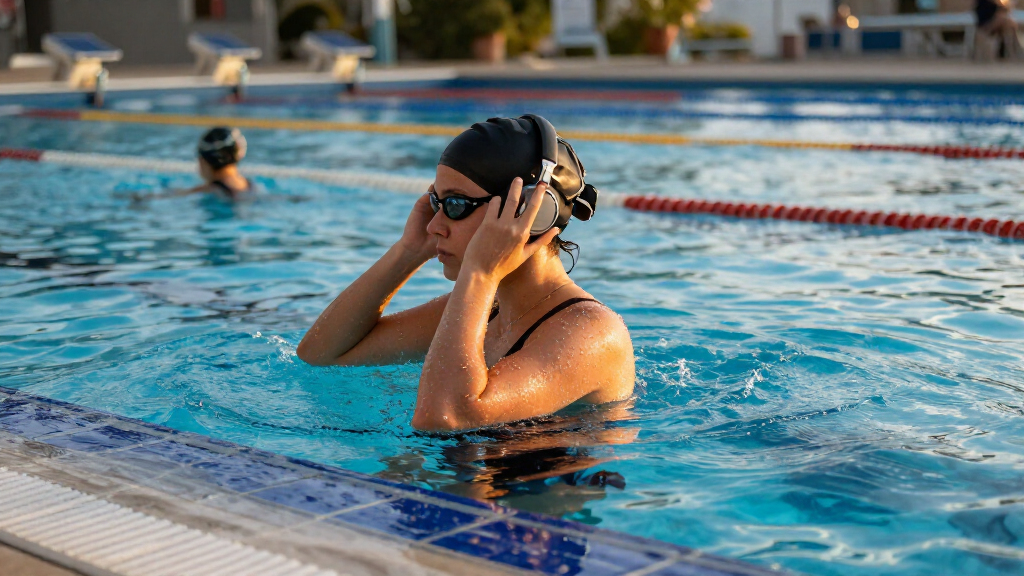
I ranked these headphones around the demands of actual swimming: waterproof suitability, dependable offline playback, secure fit, and straightforward controls. I gave more weight to a clear swimming-oriented feature set than to a newer Bluetooth version, because wireless audio is unreliable underwater and cannot replace stored music. Storage, stated battery life, charging approach, and whether a model is positioned for pool use or broader sports also shaped the order.
The Shokz OpenSwim Pro leads as the most focused swimming pick, while the H2O Audio TRI 2 earns attention for multi-sport versatility and its charging case. The PSIER, TECKNET, RR SPORTS, Tevese, MARLALL, and Sanag options cluster around the appeal of onboard MP3 storage, with differences in listed features rather than a proven performance hierarchy. I treated similarly named or repeated entries cautiously and did not infer sound quality, fit, or durability beyond the supplied product details. Since specifications alone cannot establish real-world comfort, buyers should verify the exact model, waterproof rating, and return terms before choosing.
| underwater headphones for swimming | Bluetooth |
|---|---|
| CXK GFS-G5 Waterproof Bone Con | Version 6.0; Bluetooth does not connect underwater |
| Underwater Open-Ear Swimming B | Version 6.0, land use only; dual-device connectivity |
| ZOVIMAX X7 MAX Bone Conduction | — |
| PSIER S18 Waterproof Bone Cond | Version 6.0; Bluetooth does not connect underwater |
| Opinta X7 Pro Waterproof Bone | — |
| TECKNET Bone Conduction Headph | Version 6.0 |
| PSIER X70 Bone and Air Conduct | Version 6.0 |
| RR SPORTS IP68 Waterproof Bone | Version 6.0 |
| Tevese X9 Bone Conduction Swim | Version 6.0 |
| PSIER S18A Waterproof Bone Con | — |
| Shokz OpenSwim Pro Open-Ear MP | — |
| MARLALL X26 Bone Conduction Sw | — |
| Sanag B33S Bone Conduction Hea | Bluetooth 6.0 |
| PSIER S18 Waterproof Bone Cond | — |
| H2O Audio TRI 2 Multi-Sport Wa | — |
Factors to Consider When Choosing Best Underwater Headphones For Swimming
For swimming, the most useful decision is not which headset has the longest feature list; it is which playback method, fit, and setup will work with your routine. I’d use these points to narrow the field before comparing individual listings.
Choose MP3 Playback for Time in the Water
Bluetooth and underwater listening are a poor match. Water interrupts the connection, so a phone left at the pool edge usually cannot stream steadily to headphones once you submerge. Look for a model with onboard MP3 storage if you want music or spoken audio during laps. Check how files are transferred and which formats are supported before buying; storage capacity alone does not tell you whether setup will be easy. If you swim mostly on land or want audio between pool sessions, Bluetooth can still be useful outside the water. A common mistake is choosing a headset for its Bluetooth version while overlooking whether it can play audio independently.
Read Waterproof Ratings in the Context of Your Routine
A waterproof rating is a starting point, not a guarantee of every use case. Check the exact rating on the specific listing and whether the manufacturer describes the device for swimming, not just sweat or rain. Pool laps, open-water sessions, and use near salt water can place different demands on seals and maintenance. Do not assume that two products marked waterproof have identical depth limits or care instructions. Rinse and dry the headphones as the maker directs, especially after chlorinated or salty water. If you plan to use them for frequent or long swims, favor clear swimming-specific guidance over vague wording.
Prioritize Fit and Control Access Over Small Spec Differences
A stable fit matters more than a minor feature upgrade. Headphones that shift under a swim cap or during turns can distract you, even if their storage and battery specifications look strong. Bone-conduction designs leave the ears open, but comfort and contact position still vary from person to person. Check the shape, adjustability, and return policy, and think about whether you wear goggles or a cap that could press on the headset. Physical controls are often easier to use during a workout than a phone app, but small buttons can be awkward with wet hands. If possible, choose a seller with a clear exchange process so you can resolve fit problems.
Match Storage and Battery to Your Listening Habits
More storage only helps if you want a broad offline library. A smaller capacity can be enough for a few albums or playlists, while a larger one gives more room for varied sessions and spoken audio. Check whether the product uses file transfer from a computer and whether your preferred audio files are compatible. Battery claims are most useful when compared with the length and frequency of your workouts, not as a competition on their own. Long sessions, frequent use, and time between charges all affect whether a headline runtime feels adequate. Avoid paying for capacity you will not use, but do not assume a large library will be convenient if managing files is cumbersome.
Decide Whether You Need One Headset for Multiple Sports
Swimming-first and all-sport designs solve different problems. A pool-focused headset can be the simpler choice if most of your listening happens in the water. A model positioned for running and fitness may make more sense if you also want open-ear audio on dry land, where Bluetooth and phone access are more useful. Multi-sport flexibility can reduce the need for separate devices, though extra features may add setup steps or accessories. Think through where you will store the headset, how you will charge it, and whether a charging case is genuinely useful for your routine. Choose versatility only when you expect to use it; otherwise, prioritize swimming-specific fit and offline playback.
Frequently Asked Questions
Can I stream music from my phone while my head is underwater?
Usually not reliably. Bluetooth signals do not pass well through water, so a phone on the pool deck is unlikely to maintain a steady connection to submerged headphones. For swim sessions, select a model with onboard MP3 playback and load audio before you get in. Bluetooth can still be handy before and after swimming or for workouts on land. If a listing emphasizes Bluetooth, check that it also clearly states how offline playback works.
Should I choose 8GB or 32GB of storage?
Choose based on the size of the offline library you will actually use. The ZOVIMAX X7 MAX lists 8GB, which may be enough for a focused set of playlists or a smaller collection. Several other options in this roundup specify 32GB, giving more room for varied music and spoken audio. More capacity does not automatically mean easier file transfer, so check the setup process and supported formats. If you tend to repeat the same swim playlist, paying attention to usability may matter more than the largest number.
Are bone-conduction headphones comfortable under a swim cap?
It depends on the headset shape, cap, and your fit. Bone-conduction models sit against the head rather than sealing the ear canal, but the contact points can still feel pressured or shift when combined with goggles and a cap. Check whether the product has an adjustable or flexible fit and compare its shape with your existing swim gear. If comfort is uncertain, favor a seller with clear return or exchange terms. A secure fit during turns matters more than a design that feels comfortable only while standing still.
Can I use the same headphones for pool laps and running?
Some models are positioned for both swimming and land workouts, but their strengths differ by setting. Bluetooth is more useful while running, whereas onboard MP3 playback is the practical choice in the pool. The TECKNET listing explicitly names running and fitness alongside IP68 waterproofing and MP3 mode, while the H2O Audio TRI 2 is presented as a multi-sport option. Check the exact waterproof guidance before using any headset in water, and confirm that its land-use controls work for your routine. If you mainly swim, do not trade away a secure aquatic fit for a feature you will rarely use.
Why are there two PSIER S18 entries, and how do I choose between them?
The supplied roundup list includes the PSIER S18 32GB model twice. That does not establish that the entries differ, so compare the exact product listing, model identifier, included accessories, and seller details before treating them as separate choices. The PSIER S18A is a distinct named variant in the list, but its name alone does not prove what changed. Check the stated waterproof rating, storage, controls, and return terms on the page you plan to buy from. If the listings appear identical, choose based on the clearer product information and support rather than assuming one has better performance.
Conclusion
For a best overall, swimming-first choice, I’d start with the Shokz OpenSwim Pro. The best premium-style multi-sport option in this lineup is the H2O Audio TRI 2, especially for buyers who value a charging case and broader workout use. For best value by feature set, compare the PSIER S18 32GB listings, TECKNET, and RR SPORTS against the exact waterproof details and included accessories; the supplied specs alone do not establish a single price-based winner. For beginners, I’d favor a straightforward MP3 model with clear file-transfer instructions and a return policy that makes fit testing low-risk. If you need a smaller music library, the ZOVIMAX X7 MAX’s listed 8GB may be enough; if you want one headset for swimming and land workouts, look closely at the TECKNET or H2O Audio options. Before ordering, verify the specific model’s swim rating, controls, and offline playback setup.