In table tennis, you focus on quick reflexes, rapid spins, and sharp angles using flexible grips like shakehand or penhold, with small paddles and lightweight balls. Tennis demands power, stamina, and strategic control with larger rackets and heavier balls, played on different surfaces like grass, clay, or hard courts that influence play style. Your skills and gear adapt to each sport’s environment and pace. Keep exploring to discover how these differences shape each game.
Key Takeaways
- Table tennis uses flexible grips like shakehand and penhold, focusing on rapid spins and sharp angles, while tennis employs standardized grips for power and control.
- Equipment technology, including rackets and footwear, significantly influences gameplay and performance in both sports.
- Court surface types—grass, clay, hard in tennis, vs. smooth table surface—affect ball bounce, speed, and player movement.
- Reaction time is critical in table tennis due to small playing area and fast play; tennis relies more on stamina and strategic rallies.
- Gameplay strategies differ: table tennis emphasizes quick spins and angles, whereas tennis highlights power, longer rallies, and ball control.
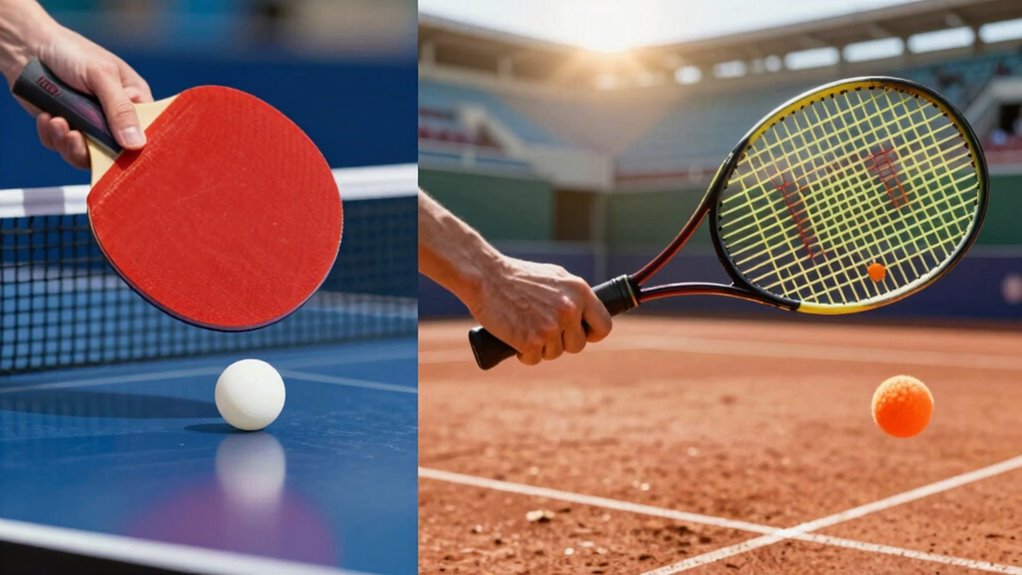
When comparing table tennis and tennis, you’ll find two sports that share similarities but also have distinct differences in gameplay, equipment, and playing environment. One of the first things you’ll notice is the way each sport requires a different approach to racket grip. In table tennis, your grip tends to be more flexible, often using the shakehand or penhold grip, which allows for quick wrist movements and precise control. This grip helps you execute rapid spins and sharp angles on a small, fast-moving ball. In tennis, your racket grip is usually more standardized, such as the continental, eastern, or semi-western grip, which are better suited for powerful swings and controlling larger, heavier balls over longer distances. These grips influence your ability to generate power and spin, shaping your overall playing style.
The court surface is another vital difference that impacts gameplay. In tennis, you’ll play on a variety of surfaces like grass, clay, or hard courts, each affecting the ball’s bounce and your movement. Grass courts tend to be faster with a lower bounce, favoring aggressive players who rely on quick serves and volleys. Clay courts slow the game down, allowing for longer rallies and emphasizing stamina and precision. Hard courts offer a more uniform bounce, blending elements of speed and endurance. Surface type significantly influences how the ball behaves and how players adapt their strategies. Additionally, the small playing area in table tennis demands exceptional reaction time and coordination, making reflexes crucial for success. A thorough understanding of technology and equipment can further enhance your gameplay in both sports, as innovations like improved rackets and footwear can provide a competitive edge.
table tennis paddle shakehand grip
As an affiliate, we earn on qualifying purchases.
As an affiliate, we earn on qualifying purchases.
Frequently Asked Questions
How Do Scoring Systems Differ Between Table Tennis and Tennis?
You’ll find that the scoring systems differ markedly between table tennis and tennis. In table tennis, scoring strategies revolve around quick point calculation, with each rally earning a point unless the game is tied at 10-10, where players need two consecutive points to win. In tennis, you count points as 15, 30, 40, and game, with games forming sets, and players must win by two points, making the scoring more complex.
What Are the Most Common Injuries in Each Sport?
In these fast-paced sports, injuries are common pitfalls you must navigate. In tennis, you’re prone to sprains, strains, and tennis elbow, while in table tennis, you might face wrist strains or shoulder overuse. To stay in the game, prioritize injury prevention through proper warm-ups, technique, and equipment. When injuries happen, recovery strategies like rest, ice, and targeted exercises help you bounce back faster. Stay vigilant and protect your body.
How Do Training Routines Vary for Table Tennis and Tennis Players?
You tailor your training routines based on the sport’s demands. For table tennis, you focus on quick reaction time, agility, and precision through drills like multi-ball practice and footwork exercises. In tennis, you emphasize power, endurance, and stroke consistency with practice techniques such as serve drills, rally sessions, and strength training. Both sports require dedicated routines, but the intensity, duration, and specific drills differ to develop the necessary skills.
Are There Specific Footwear Requirements for Each Sport?
Imagine your feet as anchors on a stormy sea—your footwear must hold firm. For table tennis, you need shoes with superior grip and flexibility, allowing swift lateral moves on a smooth surface. Tennis shoes, on the other hand, demand extra ankle support and durable traction for explosive sprints on outdoor courts. Your choice of footwear directly influences your agility, stability, and ultimately, your game’s success.
How Do Environmental Factors Affect Gameplay in Both Sports?
Environmental factors like wind interference considerably impact tennis, causing unpredictable ball trajectories and challenging your control and timing. In table tennis, wind is less of an issue, but outdoor courts can experience surface effects like unevenness or dirt, affecting ball bounce and speed. You need to adapt your gameplay accordingly—adjusting your shots in tennis and compensating for surface irregularities in outdoor table tennis matches to stay competitive.
penhold grip table tennis racket
As an affiliate, we earn on qualifying purchases.
As an affiliate, we earn on qualifying purchases.
Conclusion
In the end, whether you prefer table tennis or tennis, remember that variety is the spice of life. Both sports demand unique skills and gear, yet they share the goal of enjoying the game. As the saying goes, “Practice makes perfect,” so pick your favorite and get swinging. Embrace the differences, learn the skills, and most importantly, have fun on your athletic journey!
tennis racket for power and control
As an affiliate, we earn on qualifying purchases.
As an affiliate, we earn on qualifying purchases.

ASICS Men's Gel-Challenger 15 Clay Tennis Shoes, 11, IRONCLAD/Grey Blue
- Durable PGuard Technology: Enhances shoe durability
- Cushioned OrthoLite Sockliner: Provides cushioning and moisture control
- Stable WINGWALL Technology: Improves stability during play
As an affiliate, we earn on qualifying purchases.
As an affiliate, we earn on qualifying purchases.