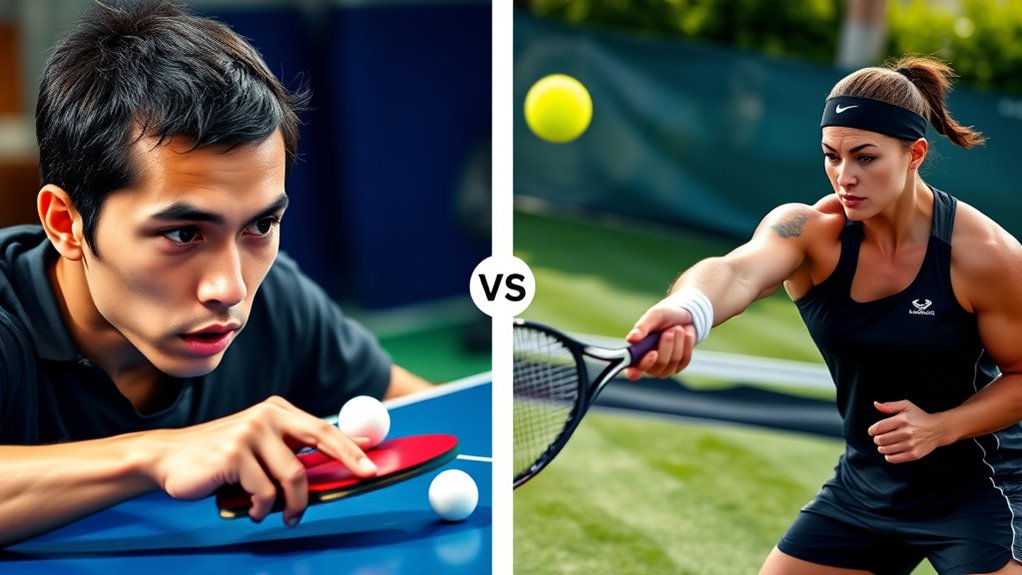

Table tennis and tennis differ greatly in skills and gear. Your equipment impacts gameplay; tennis rackets are heavier, while table tennis paddles focus on control. When considering skill, tennis emphasizes power and endurance, while table tennis requires quick reflexes and hand-eye coordination. Court size also plays a role; a larger court allows for diverse shots in tennis, while the smaller table demands rapid movement. Explore these nuances further to appreciate the unique elements of each sport.

Get workout gear delivered free — and shop member deals
- Fast, free delivery on millions of items
- Access to Prime Big Deal Days deals on October 6–7
- Prime Video, Amazon Music and more included
Key Takeaways
- Tennis rackets are heavier and longer than table tennis paddles, influencing power and spin in gameplay.
- Tennis courts are larger, allowing for diverse shot options, while table tennis requires quick reactions in a smaller area.
- Speed requirements differ: tennis focuses on moderate power and placement, while table tennis demands fast reflexes and agility.
- Skill development varies; tennis emphasizes serves and stamina, whereas table tennis hones quick hand-eye coordination and precision.
- Equipment characteristics, such as ball size and surface texture, significantly impact gameplay styles in each sport.
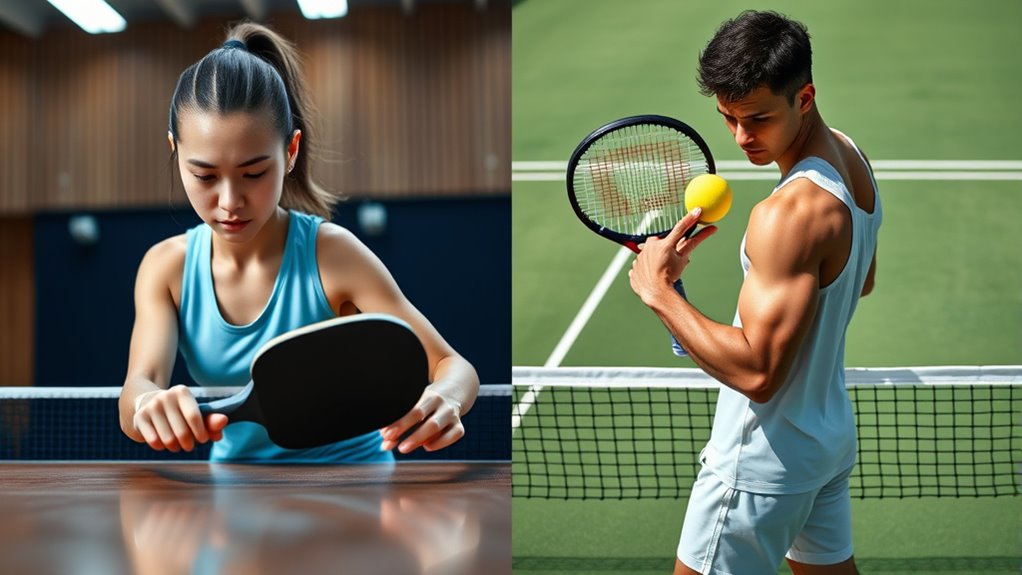
Have you ever wondered how table tennis and tennis, while sharing a name, differ so dramatically? At first glance, they might seem similar, but the equipment comparison reveals just how distinct the two sports are. When you explore the specifics, you’ll notice that the gear used in each game plays a major role in the skill development required to excel.
Table tennis and tennis may share a name, but their distinct equipment shapes unique skill sets essential for each sport.
In tennis, you’ve got a racket that’s typically longer and heavier than a table tennis paddle. The strings on a tennis racket are designed to provide power and spin, while the surface of a table tennis paddle is covered with rubber, allowing for incredible control and spin. You might also notice the balls are different; a tennis ball is larger and bouncier, while a table tennis ball is lightweight and can easily be affected by the slightest touch. These differences in equipment influence not just how you play but also how you train.
When you step onto a tennis court, you have the luxury of a larger playing area, which allows for a wider range of shot selections. You can serve, volley, and rally from the baseline, giving you various tactical options. In contrast, table tennis is played on a much smaller table, which means you have to react quickly. The speed of the game ramps up considerably, demanding faster reflexes and sharper focus. Your skill development in tennis often revolves around mastering your serve and footwork, while in table tennis, it’s about honing your quick hand-eye coordination and precision.
The differences in how you practice also stand out. In tennis, you might spend hours perfecting your serves or your backhand shots. You’d practice with a partner or hit against a wall, gradually building your strength and stamina. On the other hand, while learning table tennis, you’ll likely focus on improving your spin techniques and speed drills, often engaging in repetitive, fast-paced rallies to develop quick reactions. Additionally, the color accuracy in equipment can significantly impact your performance in both sports.
Ultimately, both sports require dedication and skill but cater to different strengths. Whether you prefer the sprawling courts of tennis or the rapid-fire action of table tennis, understanding the equipment comparison and unique skill development pathways in each sport can help you appreciate them more fully. So, which one gets your heart racing?
table tennis paddle with control rubber
As an affiliate, we earn on qualifying purchases.
As an affiliate, we earn on qualifying purchases.
Frequently Asked Questions
What Are the Health Benefits of Playing Table Tennis Versus Tennis?
Both table tennis and tennis offer fantastic health benefits. When you play table tennis, you boost your mental agility through quick reflexes and strategic thinking. It’s a great way to improve hand-eye coordination, too. Tennis, on the other hand, enhances your cardiovascular health with its continuous movement and stamina requirements. You’ll find that both sports keep you fit and active, but table tennis might sharpen your mind even more while you’re having fun!
How Do Weather Conditions Affect Each Sport’s Playability?
Weather conditions can really throw a wrench in your game. If it’s pouring rain, you’ll find table tennis unaffected, while tennis courts turn into slippery disaster zones. Ironically, you might think sun exposure would enhance play, but it can actually tire you out quicker. Plus, your gear’s durability matters; table tennis paddles handle humidity better than tennis rackets do in extreme heat. So, choose wisely based on the forecast before heading out!
What Age Is Best to Start Playing Either Sport?
The best age to start playing either sport is around 5 to 7 years old. At this age, youth development is essential, as kids can easily grasp basic skills and concepts. Starting young allows for better skill progression, enabling you to build a solid foundation. As you grow, your coordination and strategy improve, making it easier to excel. So, get started early and enjoy the journey of mastering the game!
Are There Any Common Injuries in Table Tennis and Tennis?
Playing either sport can feel like dancing on a tightrope, with injuries lurking below. In both table tennis and tennis, you might face common injuries like joint injuries and muscle strains. Those quick, repetitive movements can really take a toll on your body. It’s essential to warm up properly and focus on technique to minimize these risks. Remember, staying strong and flexible can help you enjoy the game longer without the pain.
How Do the Scoring Systems Differ in Table Tennis and Tennis?
In table tennis, you use a simple point system where a player needs 11 points to win a game, and matches are usually best of five or seven games. In contrast, tennis has more complex scoring methods, including points, games, and sets. You score points to win games, then games to win sets, and sets to win matches. Understanding these differences can help you appreciate each sport’s unique strategies and flow.
tennis racket for power and spin
As an affiliate, we earn on qualifying purchases.
As an affiliate, we earn on qualifying purchases.
Conclusion
In the end, whether you’re smashing a table tennis ball or serving up an ace on the court, both sports require skill, strategy, and passion. Just like a painter chooses different brushes for different canvases, you’ll find your groove with the right gear and mindset. Remember the time you rallied back-and-forth with a friend, laughter echoing in the air? That joy, no matter the sport, is what truly connects us. So pick up a paddle or racket and play on!
As an affiliate, we earn on qualifying purchases.
As an affiliate, we earn on qualifying purchases.
Fall Picks
fall essentials
As an affiliate, we earn on qualifying purchases.