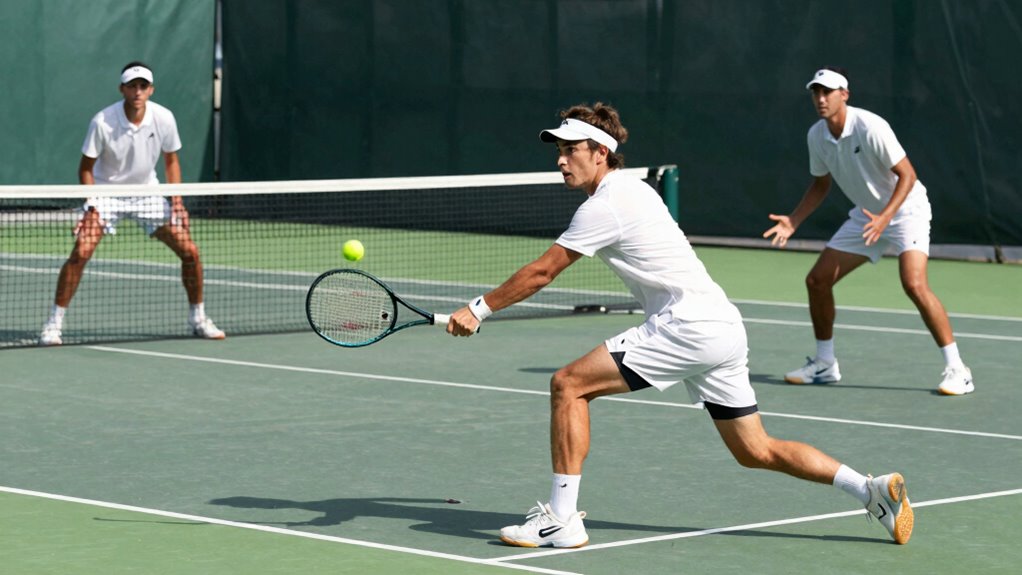

In singles, your focus is on controlling the court with precise serve placement, quick footwork, and strategic shot variation to outmaneuver your opponent. You rely on individual movement, mostly shifting toward the center after shots for balance. In doubles, teamwork and communication are key, with quick exchanges and net play dominating. You coordinate your positioning with your partner to cover angles and set up attacking shots. To master these differences, keep exploring how tactics evolve in each format.

Get workout gear delivered free — and shop member deals
- Fast, free delivery on millions of items
- Access to Prime Big Deal Days deals on October 6–7
- Prime Video, Amazon Music and more included
Key Takeaways
- Singles focus on individual court coverage, deep shot placement, and controlling the middle to dominate play.
- Doubles rely on teamwork, communication, and coordinated positioning to cover the court effectively.
- Serve strategies differ: singles use varied placement to control the game, doubles target setting up easy returns or pressure.
- Movement in singles emphasizes quick footwork and balance, while doubles prioritize rapid exchanges and net play.
- Tactical approaches vary: singles aim for shot variety and exploiting weaknesses; doubles emphasize net control and quick team adjustments.
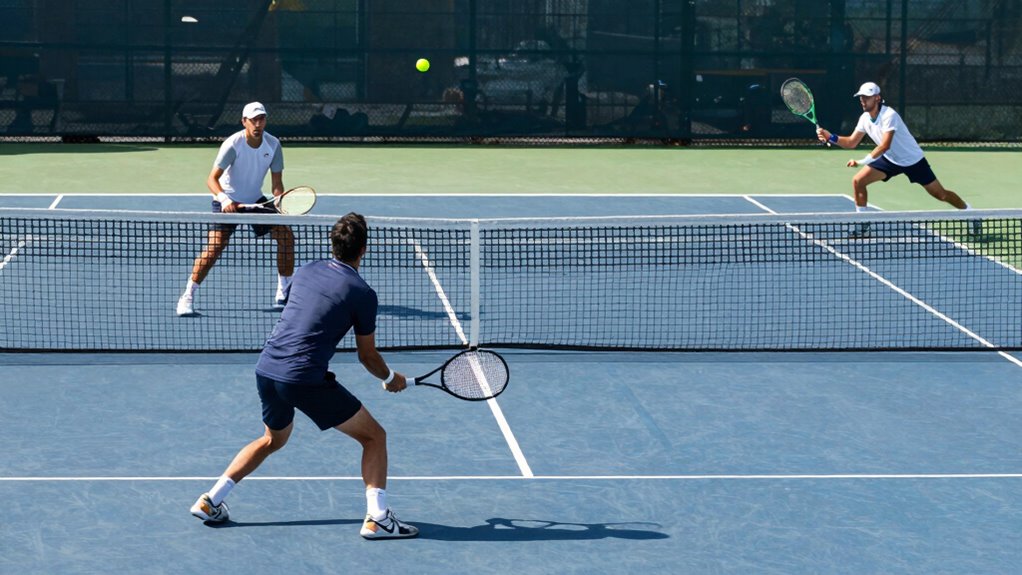
Whether you’re new to tennis or looking to deepen your understanding of the game, it’s important to recognize the key differences between singles and doubles play. One of the most noticeable distinctions lies in how you approach serve placement and court positioning. In singles, your focus is on covering the entire court, which means every shot, including your serve, must be carefully planned to control the game. You tend to serve with a mix of deep serves to push your opponent back and angled serves to open up the court. Your court positioning relies heavily on quick footwork and anticipation, as you need to cover more ground on your own. After each shot, you generally move toward the center of the court to maintain balance and prepare for the next return, giving you a strategic advantage in controlling the middle space. Additionally, singles play emphasizes court coverage and individual tactics since you are solely responsible for every aspect of the game.
In doubles, the game shifts significantly. Serve placement becomes a collaborative effort; you and your partner coordinate to target different areas of the service box, often aiming for serves that set up an easy return or put your opponents under pressure. Because you’re sharing the court, your serve can be more aggressive or varied, knowing your partner will cover the other side if needed. Court positioning in doubles revolves around teamwork and communication. You and your partner work together to cover the net and baseline, with the net player often stepping forward to intercept volleys and cut off angles. The baseline player stays back to handle deep returns, but both of you need to stay aware of your partner’s position to avoid gaps or confusion. Developing effective teamwork skills is essential for success in doubles, as coordinated movements and clear communication can make or break your game.
The differences extend to overall strategy. In singles, you control the pace and placement, aiming to outmaneuver your opponent through precise serve placement and smart court positioning. You look to exploit weaknesses and vary your shots to keep them off balance. Conversely, in doubles, your strategy involves rapid exchanges and coordinated movements. You focus on controlling the net, setting up smashes, and forcing your opponents into difficult returns. Your court positioning is dynamic, shifting quickly to adapt to your partner’s movements and the flow of the game. Incorporating effective communication can greatly enhance your ability to anticipate your partner’s movements and respond accordingly.
Ultimately, understanding these tactical nuances helps you become a more versatile player. Whether you’re serving to set up an attack or moving in tandem with a partner, mastering court positioning and serve placement tailored to singles or doubles play will elevate your game and give you a strategic edge.
tennis singles and doubles racket
As an affiliate, we earn on qualifying purchases.
As an affiliate, we earn on qualifying purchases.
Frequently Asked Questions
How Does Court Positioning Differ Between Singles and Doubles?
In singles, you focus on court coverage, staying centralized to cover as much ground as possible. In doubles, you and your partner coordinate your positioning, typically splitting the court into halves to maximize coverage and pressure opponents. You move in tandem, communicating effectively to cover lobs and volleys, ensuring you’re always prepared for quick exchanges. This strategic positioning boosts your chances of winning points in both formats.
What Are the Key Communication Strategies in Doubles Play?
Ever wondered how you and your partner stay coordinated during doubles? You should focus on clear verbal cues and subtle non-verbal signals, like eye contact or paddle positioning. These strategies help you communicate quickly and avoid confusion. By establishing consistent signals, you build trust, anticipate each other’s moves, and maintain seamless teamwork. Effective communication is the backbone of successful doubles play, ensuring you’re always one step ahead on the court.
How Do Scoring Rules Vary Between Singles and Doubles?
In singles and doubles, scoring rules have some variations you should know. While both formats follow the same core system—point, game, set, match—doubles introduces unique scoring nuances, like the “no-ad” scoring in some formats, which speeds up play. Additionally, rule variations like the “let” serve are consistent, but doubles emphasizes teamwork and court coverage, subtly affecting how you approach scoring and tactics during matches.
What Equipment Differences Are Recommended for Doubles Matches?
For doubles matches, you’ll want equipment that enhances your agility and control. Opt for a racket with a comfortable grip to handle quick exchanges, and choose shoes with excellent traction to dart around the court confidently. A slightly lighter racket can improve your swing speed, while shoes with better grip help prevent slipping during rapid side-to-side movements. This combination keeps you dynamic and ready to team up effectively.
How Does Fitness Training Differ for Singles Versus Doubles Players?
You focus your fitness training differently for singles and doubles. For singles, you prioritize endurance training to sustain long rallies and improve stamina. You also incorporate agility drills to enhance your quick movements across the court, covering more ground. In doubles, your training emphasizes rapid reflexes and quick directional changes, so agility drills are essential. While endurance remains important, your workout is more tailored to explosive movements and swift teamwork.
tennis court shoes for singles and doubles
As an affiliate, we earn on qualifying purchases.
As an affiliate, we earn on qualifying purchases.
Conclusion
Whether you’re stepping onto the court solo or with a partner, understanding the strategy differences in singles and doubles can turn the game in your favor. Think of singles as a chess match—every move counts—while doubles feels like a lively dance, where coordination and communication lead the way. Embrace these nuances, and you’ll navigate each game with confidence, making every rally a thrilling chapter in your tennis story. Ultimately, mastering both styles makes you a more versatile player on the court.
tennis training drills for singles and doubles
As an affiliate, we earn on qualifying purchases.
As an affiliate, we earn on qualifying purchases.
As an affiliate, we earn on qualifying purchases.
Fall Picks
fall essentials
As an affiliate, we earn on qualifying purchases.