TL;DR

Get workout gear delivered free with Prime
- Fast, free delivery on millions of items
- Prime Video, Amazon Music and more included
- Member-only deals all year
A Fit&Well report describes a floor-to-stand fitness test and a mobility drill recommended by coach Yancy Culp. Research has associated lower scores on a related sitting-rising test with higher mortality, but that association does not show that difficulty standing causes poor health or predicts an individual’s lifespan.
A Fit&Well report describes a simple fitness check—sitting on the floor and standing up without using the hands—and a mobility drill recommended by coach Yancy Culp for people who struggle with it. The test can call attention to movement challenges, but a low score is not a diagnosis: research cited in the report found an association between lower results on a related test and higher mortality, not proof that difficulty rising causes illness or predicts what will happen to any one person.
The report lists five checks Culp designed to help people assess whether they can perform basic movements: balancing on one leg while doing a task, rising from the floor without the hands, holding a plank for 30 seconds, completing two reverse lunges and walking briskly for 20 minutes. The article’s writer says they struggled with the floor-to-stand task. These are presented as informal fitness checks, not as a clinical assessment.
The floor-rise challenge is described as a variation of the sitting-rising test, developed by Brazilian researchers in the 1990s to assess muscular strength and flexibility. The report cites a 2014 study in the European Journal of Preventive Cardiology that found lower test scores were associated with higher mortality rates. The source does not provide the study’s participant details, effect size or a basis for applying its findings to an individual.
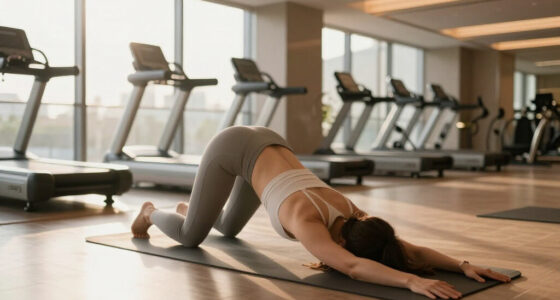
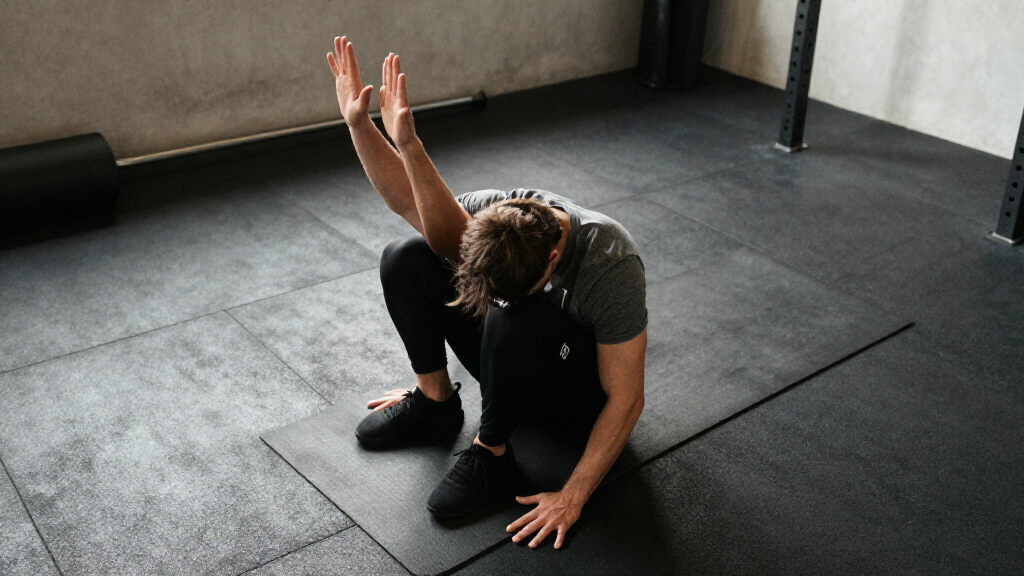
Asked how to work on the movement, Culp recommended practicing knee rolls. From a seated position, with knees bent and legs resting on the floor, roll both knees from one side to the other while keeping the feet in contact with the ground. Culp suggested repeating the movement for 20 reps daily, leaning forward at the end of each roll, and using the hands for support if needed. This is his coaching advice, rather than a treatment supported by evidence presented in the report.
A Movement Check, Not a Diagnosis
Getting down to and up from the floor draws on several abilities, including mobility, strength and balance. Difficulty with the task may give someone a reason to pay attention to how they move or to seek qualified guidance, particularly if the problem is new or affects daily activities.
The mortality finding needs careful interpretation. An association between test scores and outcomes across a study group does not establish that a low score itself causes a health problem, and it cannot determine an individual’s future. The test can be a prompt for discussion, but it should not be treated as a stand-alone measure of overall health or lifespan.
Products Worth Considering

Bowflex PR1000 Home Gym

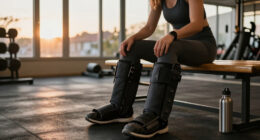
Hyperice Normatec 3 Leg Compression Boots – Standard Size

Levoit Eleva 300X HEPA Air Purifier for Home and Bedroom
As an affiliate, we earn on qualifying purchases.
How the Floor-Rise Test Fits
The sitting-rising test has been used as a way to assess physical function, while Culp’s version appears in a set of five basic movement checks. In the report, the test is framed as a way to “check in” with the body—not as a replacement for a medical evaluation or a formal fitness assessment.
Culp is identified by Fit&Well as a coach, co-creator of Spartan DEKA and senior director who has trained obstacle-course racers. His advice in the article focuses on hip and overall mobility. The source recounts the journalist’s experience and Culp’s recommendation; it does not report a controlled trial showing that knee rolls improve test scores or change health outcomes.
“Improving hip and overall mobility is very important for this one.”
— Yancy Culp, as quoted by Fit&Well
Limits of the Evidence and Advice
The report does not give enough detail about the 2014 study to assess its methods, the size of the association or how factors such as age and existing health conditions were handled. It also does not establish that failing the test predicts mortality for a particular person. Association is not causation, and a result can reflect multiple factors.
There is no outcome data in the source showing whether the knee-roll drill helps people stand without their hands, how quickly any change might occur, or whether 20 daily repetitions suit everyone. People who feel pain, dizziness or instability should stop rather than force the movement. Anyone with a health condition, recent injury or concern about falls should ask a healthcare professional or qualified exercise specialist for advice before trying it.
How to Use the Check Safely
The report offers a practical next step: try the movement only in a safe space, use the hands for support when needed and treat the result as a personal observation—not a pass-or-fail verdict on health. Culp’s knee rolls are one suggested mobility exercise, not a guaranteed way to improve the test.
Fit&Well’s source does not announce a follow-up study or further testing. For readers concerned about mobility or repeated difficulty getting up, the sensible next step is to discuss the issue with a healthcare professional, who can consider the person’s circumstances and advise on appropriate activity.
Key Questions
What does the floor-to-stand test involve?
It asks you to sit on the floor and return to standing without using your hands. The version described by Fit&Well is a variation of the sitting-rising test.
Does struggling with the test mean I am unhealthy?
No. The test is an informal movement check, not a diagnosis. Difficulty can have many explanations, and the association with mortality cited in the report does not predict an individual’s health outcome.
What are knee rolls?
They involve sitting with bent knees and rolling them from side to side while the feet stay in contact with the floor. Culp suggested 20 repetitions daily, with hands available for support if needed.
Should I try the exercise if I have pain or balance problems?
Do not force a movement that causes pain, dizziness or instability. If you have a health condition, injury or fall risk, seek guidance from a healthcare professional or qualified exercise specialist first.
Source: rss