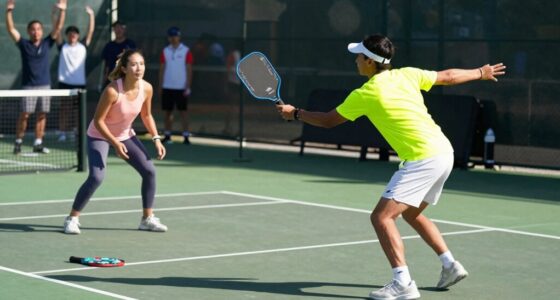
When comparing badminton and tennis, badminton often challenges you more regarding agility and quick reflexes. The fast-paced rallies demand sharp movements and quick decision-making. While tennis requires power and endurance, the shorter court in badminton means you’re constantly on the move. Each sport has its unique tests, but badminton’s pace can make it tougher to master. If you want to explore the nuances and intricacies of both sports further, there’s so much more to discuss.

Get workout gear delivered free — and shop member deals
- Fast, free delivery on millions of items
- Access to Prime Big Deal Days deals on October 6–7
- Prime Video, Amazon Music and more included
Key Takeaways
- Badminton requires quick reflexes and agility due to its fast-paced rallies, demanding sharp movements and decisions.
- Tennis emphasizes power and precision, testing players’ stamina and strategic positioning over longer rallies.
- The smaller court size in badminton promotes quicker exchanges, while tennis courts require more extensive movement and court coverage.
- Badminton’s rally scoring allows for rapid momentum shifts, whereas tennis’s advantage scoring can prolong matches and create tension.
- Both sports challenge mental sharpness, but the nature of gameplay dynamics differs significantly, affecting overall difficulty and player experience.
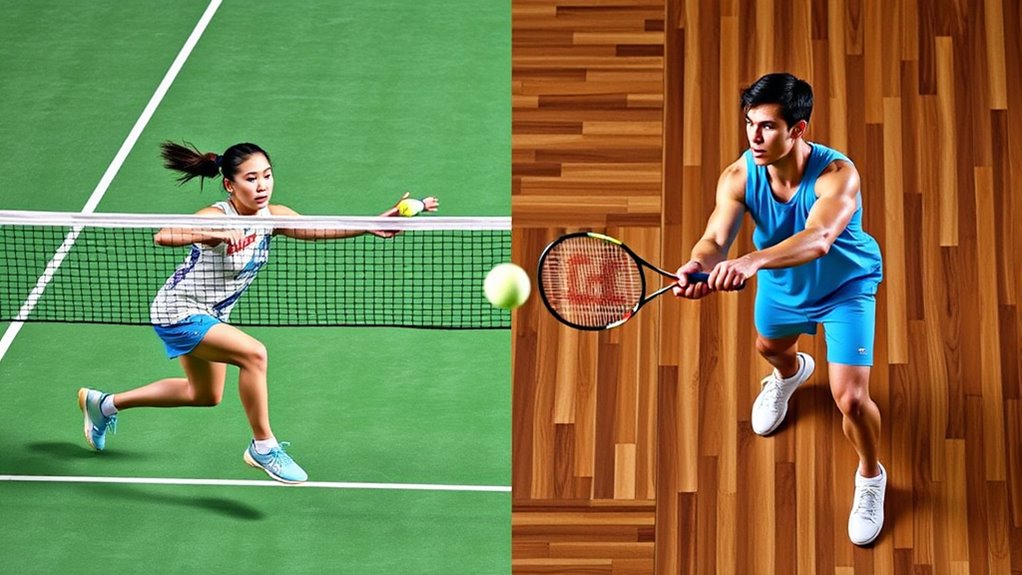
Have you ever wondered how badminton stacks up against tennis? Both sports share similarities, yet they present distinct challenges that can influence your experience as a player. When it comes to court surface, badminton is typically played on a wooden or synthetic surface, while tennis is often played on grass, clay, or hard courts. Each surface affects the game differently, influencing how the ball or shuttlecock travels and how you move. On a badminton court, the quick pace and smaller dimensions encourage swift footwork and sharp reflexes, while in tennis, the larger court requires a broader range of movement and strategic positioning.
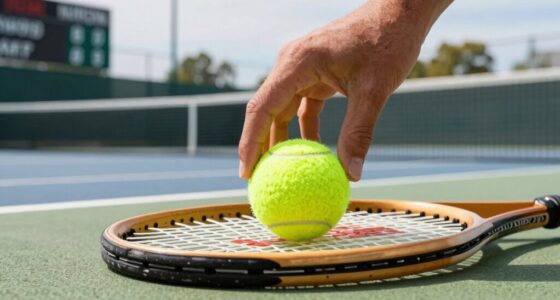
Now, let’s explore the equipment differences that set these two sports apart. In badminton, you use a racket that’s lightweight and designed with a smaller head, allowing for rapid swings and quick shots. The shuttlecock, or birdie, is another unique element, as it’s designed to create drag, making it less predictable in flight. In comparison, tennis rackets are heavier and have a larger head, enabling you to generate more power and control over the tennis ball. The ball itself bounces higher on different surfaces, requiring you to adjust your strategy and shot selection accordingly.
Exploring the distinct equipment of badminton and tennis reveals unique gameplay dynamics and strategies for each sport.
When you consider the gameplay, badminton tends to emphasize quick reflexes and agility. You’ll often find yourself engaging in fast-paced rallies, where every second counts. This quickness demands not only physical readiness but also mental sharpness. Tennis, on the other hand, combines power, precision, and stamina. The longer rallies can test your endurance, making every point a battle of strategy as much as skill. You’ll need to think ahead, setting up for that perfect shot while also anticipating your opponent’s next move.
Lastly, let’s not forget about the scoring systems. Badminton employs a rally scoring system, where points can be won regardless of who serves. This can lead to quick shifts in momentum, keeping you on your toes. Tennis, with its unique advantage scoring, can extend matches and create tense situations, especially during critical moments.
Additionally, both sports promote sustainable living practices through eco-friendly equipment options and facility management, encouraging players to be mindful of their environmental impact. Ultimately, whether you find badminton or tennis more challenging depends on your personal strengths and preferences. Each sport offers a unique set of skills to master, ensuring that both can be incredibly rewarding and enjoyable. So, which one will you choose to explore next?
As an affiliate, we earn on qualifying purchases.
Frequently Asked Questions
What Are the Essential Skills Needed for Badminton and Tennis?
To excel in badminton and tennis, you need strong footwork techniques and excellent racket handling skills. You’ll want to develop agility and quick reflexes for maneuvering around the court effectively. Racket handling is vital; mastering grip, swing, and control allows you to deliver powerful shots. Additionally, focus on strategic shot placement and consistency to outsmart your opponents. Practicing these essential skills regularly will greatly enhance your performance in both sports.
How Do Injuries Compare Between Badminton and Tennis Players?
When you’re in the thick of it, injuries can really take the wind out of your sails. In badminton, players often face ankle sprains and shoulder injuries due to quick movements and overhead shots. Tennis players might deal with tennis elbow and knee injuries from repetitive motions and hard court impacts. Recovery processes vary, with badminton players needing agility-focused rehab, while tennis players often focus on strength and stability to bounce back effectively.
What Is the Average Lifespan of a Professional Player in Each Sport?
The average career longevity of a professional badminton player typically ranges from 10 to 15 years, while tennis players often enjoy a slightly longer span, around 15 to 20 years. You’ll find that badminton players usually retire in their late 20s to early 30s, whereas tennis players often play into their mid-30s. Factors like injury rates and physical demands considerably influence retirement age in both sports, affecting overall career durations.
Are There Significant Differences in Training Methods for Both Sports?
The training regimes for badminton and tennis could make Olympians seem like couch potatoes. In badminton, you’ll focus on agility, speed, and quick reflexes, while tennis emphasizes endurance and powerful strokes. Coaching strategies differ, too; badminton coaches often prioritize footwork and shuttle control, whereas tennis coaches might concentrate on serve techniques and match strategies. Both sports require dedication, but the specific training methods set them apart, shaping how you develop your skills.
How Do Scoring Systems Differ Between Badminton and Tennis?
In badminton, you score a point every time your opponent fails to return the shuttlecock, regardless of who served, making point allocation straightforward. Tennis, on the other hand, has a more complex scoring system, where players must win games to win sets, and sets to win matches. You can win points on your serve or your opponent’s, adding layers to the scoring complexity that requires strategic thinking throughout the game.
As an affiliate, we earn on qualifying purchases.
Conclusion
In the end, whether badminton or tennis is more challenging really depends on your perspective and skill set. Did you know that a professional badminton shuttlecock can travel at speeds over 260 mph, making it one of the fastest sports in the world? With such intensity and quick reflexes required, you might find badminton just as demanding as tennis. So, why not give both a try and see which one truly tests your limits?
badminton shuttlecock high quality
As an affiliate, we earn on qualifying purchases.
As an affiliate, we earn on qualifying purchases.
As an affiliate, we earn on qualifying purchases.
Halloween Picks
halloween
As an affiliate, we earn on qualifying purchases.